The intensity ratio of two waves is $1 : 16$. The ratio of their amplitudes is
Easy


Download our appand get started for free
Experience the future of education. Simply download our apps or reach out to us for more information. Let's shape the future of learning together!No signup needed.*
Similar Questions
- 1On sounding tuning fork $A$ with another tuning fork $B$ of frequency $384 Hz, 6$ beats are produced per second. After loading the prongs of $A$ with some wax and then sounding it again with $B, 4$ beats are produced per second. What is the frequency of the tuning fork $A$ .... $Hz$View Solution
- 2$4.0 \,g$ of a gas occupies $22.4$ litres at $NTP.$ The specific heat capacity of the gas at constant volume is $5.0 \,\,J K^{-1} mol^{-1}$. If the speed of sound in this gas at $NTP$ is $952\, m s^{-1}$, then the heat capacity at constant pressure is .... $J K^{-1} mol^{-1}$ (Take gas constant $R = 8.3 \,\,J K^{-1} mol^{-1}$)View Solution
- 3The length of two open organ pipes are $l$ and $(l + \Delta l)$ respectively. Neglecting end correction, the frequency of beats between them will be approximately (Here $v$ is the speed of sound)View Solution
- 4If the length of a stretched string is shortened by $40\%$ and the tension is increased by $44\%$, then the ratio of the final and initial fundamental frequencies isView Solution
- 5A uniform string oflength $20\ m$ is suspended from a rigid support. A short wave pulse is introduced at its lowest end. It starts moving up the string. The time taken to reach the supports is (take $g= 10 $ $ms^{-2}$ )View Solution
- 6The equation of stationary wave along a stretched string is given by $y = 5\sin \frac{{\pi x}}{3}\cos 40\pi t$, where $x $ and $y$ are in $cm$ and $t$ in second. The separation between two adjacent nodes is..... $cm$View Solution
- 7For a certain organ pipe three successive resonance frequencies are observed at $425 \,\,Hz$, $595\,\, Hz$ and $765\,\, Hz$ respectively. If the speed of sound in air is $340 \,\,m/s$, then the length of the pipe is .... $m$View Solution
- 8A man stands in front of a hillock and fires a gun. He hears an echo after $1.5\, sec$. The distance of the hillock from the man is ...... $m$ (velocity of sound in air is $330\, m/s$)View Solution
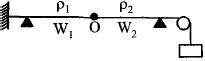
- 9Two wires $W_1$ and $W_2$ have the same radius $r$ and respective densities ${\rho _1}$ and ${\rho _2}$ such that ${\rho _2} = 4{\rho _1}$. They are joined together at the point $O$, as shown in the figure. The combination is used as a sonometer wire and kept under tension $T$. The point $O$ is midway between the two bridges. When a stationary waves is set up in the composite wire, the joint is found to be a node. The ratio of the number of an tin odes formed in $W_1$ to $W_2$ isView Solution
- 10View SolutionWhich of the following statements are wrong about the velocity of sound in air: