The internal resistance of a cell is the resistance of
AIIMS 2001, Easy


Download our appand get started for free
Experience the future of education. Simply download our apps or reach out to us for more information. Let's shape the future of learning together!No signup needed.*
Similar Questions
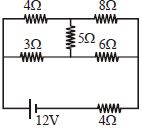
- 1In the given figure the ratio of current in $8\,\Omega $ and $3\,\Omega $ will beView Solution
- 2Two resistances are connected in two gaps of a meter bridge. The balance point is $20\, cm$ from the zero end. A resistance of $15\, ohms$ is connected in series with the smaller of the two. The null point shifts to $40\, cm$. The value of the smaller resistance in $ohms$ isView Solution
- 3A thermocouple of negligible resistance produces an $e.m.f.$ of $40\,\mu V{/^o}C$ in the linear range of temperature. A galvanometer of resistance $10\; ohm$ whose sensitivity is $1\;\mu A/div$, is employed with the thermocouple. The smallest value of temperature difference that can be detected by the system will beView Solution
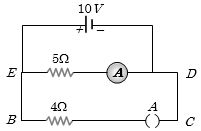
- 4In the given figure, when key $A$ is opened, the reading of the ammeter $A$ will be ........... $A$View Solution
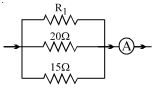
- 5In the given circuit the current flowing through the resisitance $20$ $\mathrm{ohms}$ is $0.3$ $\mathrm{ampere}$ while the ammeter reads $0.8$ $\mathrm{ampere}.$ What is the value of $R_1$? ................ $\mathrm{ohm}$View Solution
- 6View SolutionThe current in the adjoining circuit will be
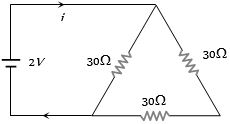
- 7In the figure shown, if the internal resistance of the battery is $1\, ohm$ , the reading of the ammeter will be ................. $\mathrm{A}$View Solution
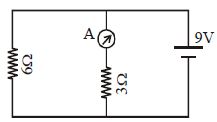
- 8When three identical bulbs of $60 \;W, 200\;V$ rating are connected in series to a $200 \;V$ supply, the power drawn by them will be ....... $Watt$View Solution
- 9Three copper rods are subjected to different potential difference. Compare the drift speed of electrons through them. Assume that all $3$ are at the same temperature.View Solution
Length Diameter Potential difference $(A)$ $L$ $3d$ $V$ $(B)$ $2L$ $d$ $2V$ $(C)$ $3L$ $2d$ $2V$ - 10A hollow cylindrical conductor has length of $3.14\,m$, while its inner and outer diameters are $4\,mm$ and $8\,mm$ respectively. The resistance of the conductor is $n \times 10^{-3}\,\Omega$.If the resistivity of the material is $2.4 \times 10^{-8}\,\Omega\,m$. The value of $n$ is $..........$View Solution