The length of a metal wire is $l_1$, when the tension in it is $T_1$ and is $l_2$ when the tension is $T_2$. The unstretched length of the wire is
Diffcult


Download our appand get started for free
Experience the future of education. Simply download our apps or reach out to us for more information. Let's shape the future of learning together!No signup needed.*
Similar Questions
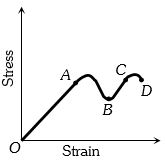
- 1In the below graph, point $D$ indicatesView Solution
- 2When a force is applied on a wire of uniform cross-sectional area $3 \times {10^{ - 6}}\,{m^2}$ and length $4m$, the increase in length is $1\, mm.$ Energy stored in it will be $(Y = 2 \times {10^{11}}\,N/{m^2})$View Solution
- 3A wire of length $L,$ area of cross section $A$ is hanging from a fixed support. The length of the wire changes to $L_{1}$ when mass $M$ is suspended from its free end. The expression for Young's modulus isView Solution
- 4View SolutionThe Young's modulus of steel is twice that of brass. Two wires of same length and of same area of cross section, one of steel and another of brass are suspended from the same roof. If we want the lower ends of the wires to be at the same level, then the weights added to the steel and brass wires must be in the ratio of
- 5A force $F$ is applied on a square area of side $L$. If the percentage error in the measurement of $L$ is $2 \%$ and that in $F$ is $4 \%$, what is the maximum percentage error in pressure?View Solution
- 6A wire is suspended by one end. At the other end a weight equivalent to $20\, N$ force is applied. If the increase in length is $1.0\, mm,$ the ratio of the increase in energy of the wire to the decrease in gravitational potential energy when load moves downwards by $1\, mm,$ will beView Solution
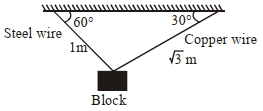
- 7A block of weight $100 N$ is suspended by copper and steel wires of same cross sectional area $0.5 cm ^2$ and, length $\sqrt{3} m$ and $1 m$, respectively. Their other ends are fixed on a ceiling as shown in figure. The angles subtended by copper and steel wires with ceiling are $30^{\circ}$ and $60^{\circ}$, respectively. If elongation in copper wire is $\left(\Delta \ell_{ C }\right)$ and elongation in steel wire is $\left(\Delta \ell_{ s }\right)$, then the ratio $\frac{\Delta \ell_{ C }}{\Delta \ell_{ S }}$ is. . . . . .View Solution
[Young's modulus for copper and steel are $1 \times 10^{11} N / m ^2$ and $2 \times 10^{11} N / m ^2$ respectively]
- 8When a certain weight is suspended from a long uniform wire, its length increases by one $cm$. If the same weight is suspended from another wire of the same material and length but having a diameter half of the first one, the increase in length will be ......... $cm$View Solution
- 9Young’s moduli of two wires $A$ and $B$ are in the ratio $7 : 4$. Wire $A$ is $2\, m$ long and has radius $R$. Wire $A$ is $2\, m$ long and has radius $R$. Wire $B$ is $1.5\, m$ long and has radius $2\, mm$. If the two wires stretch by the same length for a given load, then the value of $R$ is close to ......... $mm$View Solution
- 10The work per unit volume to stretch the length by $1\%$ of a wire with cross sectional area of $1\,m{m^2}$ will be. $[Y = 9 \times {10^{11}}\,N/{m^2}]$View Solution