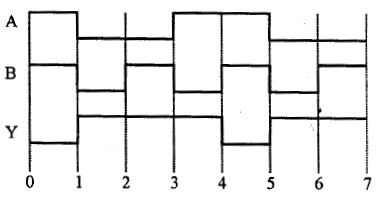
The linewidth of a bright fringe is sometimes defined as the separation between the points on the two sides of the central line where the intensity falls to half the maximum. Find the linewidth of a bright fringe in a Young's double slit experiment in terms of $\lambda$, d and D where the symbols have their usual meanings.
Download our app for free and get started
The line width of a bright fringe is sometimes defined as the separation between the points on the two sides of the central line where the intensity falls to half the maximum.
We know that, for intensity to be half the maximum,
$\text{y}=\pm\frac{\lambda}{4\text{d}}$
$\therefore$ Line width $=\frac{\lambda\text{D}}{4\text{d}}+\frac{\lambda\text{D}}{4\text{d}}=\frac{\lambda\text{D}}{2\text{d}}.$
Download our app
and get started for free
Experience the future of education. Simply download our apps or reach out to us for more information. Let's shape the future of learning together!No signup needed.*
Unpolarised light is passed through a polaroid $P_1$. When this polarised beam passes through another polaroid $P_2$ and if the pass axis of $\mathrm{P}_2$ makes angle $\theta$ with the pass axis of $\mathrm{P}_1$, then write the expression for the polarised beam passing through $\mathrm{P}_2$. Draw a plot showing the variation of intensity when $\theta$ varies from 0 to $2 \pi$.
In double-slit experiment using light of wavelength 600 nm, the angular width of a fringe formed on a distant screen is 0.1º. What is the spacing between the two slits?
Answer the following question:
Ray optics is based on the assumption that light travels in a straight line. Diffraction effects (observed when light propagates through small apertures/slits or around small obstacles) disprove this assumption. Yet the ray optics assumption is so commonly used in understanding location and several other properties of images in optical instruments. What is the justification?
A transparent paper (refractive index = 1.45) of thickness 0.02mm is pasted on one of the slits of a Young's double slit experiment which uses monochromatic light of wavelength 620nm. How many fringes will cross through the centre if the paper is removed?
A source emitting light of wavelengths 480nm and 600nm is used in. a double slit interference experiment. The separation between the slits is 0.25mm and the interference is observed on a screen placed at 150cm from the slits. Find the linear separation between the first maximum (next to the central maximum) corresponding to the two wavelengths.
Find the intensity at a point on a screen in Young’s double slit experiment where the interfering waves of equal intensity have a path difference of (i) $\lambda/4$, and (ii) $\lambda/3$.
Two towers on top of two hills are 40 km apart. The line joining them passes 50 m above a hill halfway between the towers. What is the longest wavelength of radio waves, which can be sent between the towers without appreciable diffraction effects?
Distinguish between polarised and unpolarized light. Does the intensity of polarised light emitted by a Polaroid depend on its orientation? Explain briefly.
The vibrations in a beam of polarised light make an angle of 60° with the axis of the polaroid sheet. What percentage of light is transmitted through the sheet?