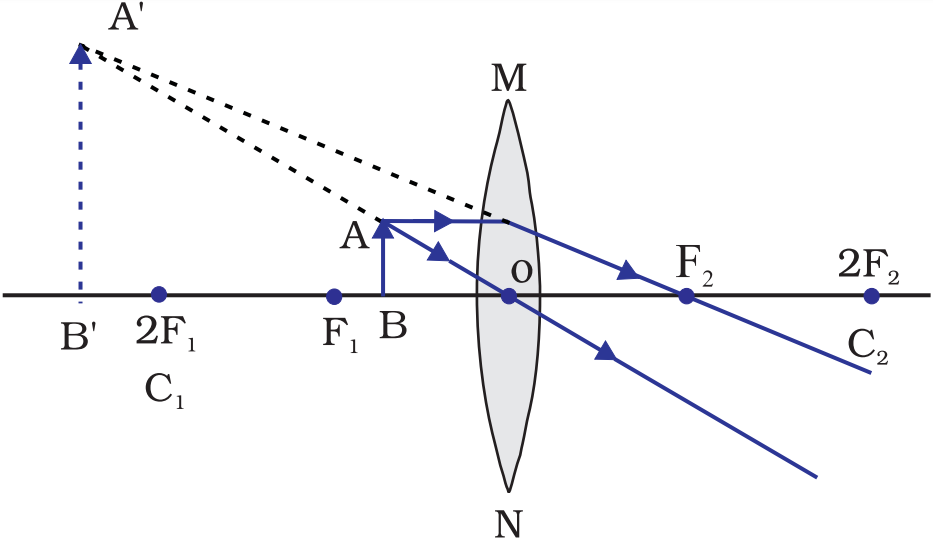
The magnification of an image formed by a lens is -1. If the distance of the image from the optical centre of the lens is 25 cm, where is the object placed? Find the nature and focal length of the lens. If the object is displaced 15 cm towards the optical centre of the lens, where would the image be formed? Draw a ray diagram to justify your answer.
CBSE FOREIGN - SET 1 2017
Download our app for free and get started
- (m = -1, means that the image is real, inverted and of the same size as the object).
$\therefore\text{f}=\frac{25}{2}=12.5\text{cm}$
- Nature of the lens is convex/converging.
- On displacing the object distance by 15 cm, towards the lens, the object distance becomes 10 cm which is less than the focal length. Image formed now is virtual/same side of lens as the object.

Download our appand get started for free
Experience the future of education. Simply download our apps or reach out to us for more information. Let's shape the future of learning together!No signup needed.*
Similar Questions
- 1View SolutionA student wants to project the image of a candle flame on a screen 90 cm in front of a mirror by keeping the flame at a distance of 15 cm from its pole.
- Suggest the type of mirror he should use.
- Determine the linear magnification in this case.
- Find the distance between the object and its image.
- Draw ray diagram to show the image formation in this case.
- 2View SolutionThe radius of curvature of a concave mirror is 50cm. Where should an object be placed in the mirror, so as to form its image at infinity? Justify your answer.
- 3The refractive index of glass with respect to air is $\frac{3}{2}$ and refractive index of water with respect to air is $\frac{4}{3}$ . What will be the refractive index of water with respect to glass?View Solution
- 4View SolutionDefine 'refractive index of transparent medium'. What is its unit? Which has a higher refractive index, glass or water?
- 5View SolutionA concave mirror has a focal length of 4cm and an object 2cm tall is placed 9cm away from it. Find the nature, position and size of the image formed.
- 6View SolutionA dentist’s mirror has a radius of curvature of 3cm. How far must it be placed from a small dental cavity to give a virtual image of the cavity that is magnified five times?
- 7View Solution
- Draw a ray diagram to show the refraction of light through a glass slab and mark angle of refraction and the lateral shift suffered by the ray of light while passing through the slab.
- If the refractive index of glass for light going from air to glass is 3/2, find the refractive index of air for light going from glass to air.
- 8View SolutionGiving reasons, state the ‘signs’ (positive or negative) which can be given to the following:
- Object distance (u) for a concave mirror or convex mirror.
- Image distances (v) for a concave mirror.
- Image distances (v) for a convex mirror.
- 9View SolutionA student uses a lens of focal length -50cm. What is the nature of the lens and its power?
- 10View SolutionThe power of a combination of two lenses X and Y is 5D. If the focal length of lens X be 15cm:
- Calculate the focal length of lens Y.
- State the nature of lens Y.