MCQ
The molar heat capacity in a process of a diatomic gas if it does a work of $\frac{Q}{4}$ when a heat of $Q$ is supplied to it is
  • A
    $\frac{2}{5}R$
  • B
    $\frac{5}{2}R$
  • $\frac{{10}}{3}R$
  • D
    $\frac{6}{7}R$

Answer

Correct option: C.
$\frac{{10}}{3}R$
c
(c) $dU = {C_V}dT = \left( {\frac{5}{2}R} \right)dT$or $dT = \frac{{2(dU)}}{{5R}}$…..$(i)$
From first law of thermodynamics

$dU = dQ - dW$$ = Q - \frac{Q}{4}$$ = \frac{{3Q}}{4}$.

Now molar heat capacity $C = \frac{{dQ}}{{dT}} = \frac{Q}{{\frac{{2(dU)}}{{5R}}}} = \frac{{5RQ}}{{2\left( {\frac{{3Q}}{4}} \right)}} = \frac{{10}}{3}R$.

Need a full question paper?

Generate a complete, print-ready paper with questions like this in minutes — across 16+ boards, with answer keys.
Start Generating Free

Similar questions

The temperature of sun is $5500 K$ and it emits maximum intensity radiation in the yellow region $(5.5 \times {10^{ - 7}}m)$. The maximum radiation from a furnace occurs at wavelength $11 \times {10^{ - 7}}m.$The temperature of furnace is ....... $K$
A balloon is rising with a constant acceleration of $2\ m/ s^2.$ At a certain instant when the balloon was moving with a velocity of $4\ m/ s,$ a stone was dropped from it in a region where $g = 10\ m/ s^2.$ The velocity and acceleration of stone as it comes out from the balloon are respectively $($in $m/ s$ and $m/ s^2)$
The maximum horizontal range of a projectile is $400\, m$. The maximum value of height attained by it will be    ......... $m$
A train is moving towards north. At one place it turns towards north-east, here we observe that
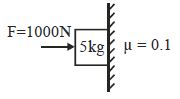
For the given figure, if block remains in equilibrium position then find frictional force between block and wall ........ $N$ 
If $L , C$ and $R$ are the self inductance, capacitance and resistance respectively, which of the following does not have the dimension of time?
A body of mass ${m_1}$is moving with a velocity $V$. It collides with another stationary body of mass ${m_2}.$ They get embedded. At the point of collision, the velocity of the system
The graph between velocity and position for a damped oscillation will be
Two particles $A$ and $B$ are moving in a straight line with the same speed. Which of the following statement (s) is/ are correct for the relative motion of the two particles?
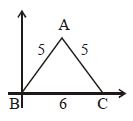
A thin uniform wire is bent to form the two equal sides $AB$ and $AC$ of triangle $ABC$, where $AB = AC = 5\,cm.$ The third side $BC$, of length $6\,cm,$ is made from  uniform wire of twice the density of the first. The distance of centre of mass from $A$ is