The musical interval between two tones of frequencies $320 Hz$ and $240 Hz$ is
Easy


Download our appand get started for free
Experience the future of education. Simply download our apps or reach out to us for more information. Let's shape the future of learning together!No signup needed.*
Similar Questions
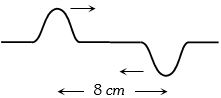
- 1Two pulses in a stretched string whose centres are initially $8 cm$ apart are moving towards each other as shown in the figure. The speed of each pulse is $2 cm/s$. After $2$ seconds, the total energy of the pulses will beView Solution
- 2$16$ tunning forks are arranged in the order of increasing frequencies. Any two successive forks give $8$ beats per sec when sounded together. If the frequency of the last fork is twice the first, then the frequency of the first fork isView Solution
- 3The equations of two waves are given byView Solution
$y_{1}=5 \sin 2 \pi(x-v t) \,c m\,$
$y_{2}=3 \sin 2 \pi(x-v t+1.5) \,c m$
These waves are simultaneously passing through a string. The amplitude of the resulting wave is.........$cm$
- 4The equation of displacement of two waves are given as ${y_1} = 10\sin \left( {3\pi t + \frac{\pi }{3}} \right)$; ${y_2} = 5(\sin 3\pi t + \sqrt 3 \cos 3\pi t)$. Then what is the ratio of their amplitudesView Solution
- 5View SolutionAs a wave propagates
- 6In stationary waves, distance between a node and its nearest antinode is $20 cm$. The phase difference between two particles having a separation of $60 cm$ will beView Solution
- 7The equation of a travelling wave is $y = 60\cos (1800t - 6x)$ where $y$ is in microns, $t$ in seconds and $x$ in metres. The ratio of maximum particle velocity to velocity of wave propagation isView Solution
- 8A source and an observer move away from each other with a velocity of $10\; m/s$ with respect to ground. If the observer finds the frequency of sound coming from the source as $1950 \;Hz$, then actual frequency of the source is .... $Hz$ (velocity of sound in air = $340\; m/s$)View Solution
- 9Equation of motion in the same direction is given by ${y_1} = A\sin (\omega t - kx)$, ${y_2} = A\sin (\omega t - kx - \theta )$. The amplitude of the medium particle will beView Solution
- 10A police car horn emits a sound at a frequency $240 Hz$ when the car is at rest. If the speed of the sound is $330 m/s$, the frequency heard by an observer who is approaching the car at a speed of $11 m/s,$ is ... $Hz$View Solution