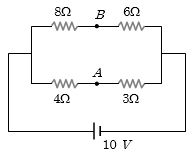
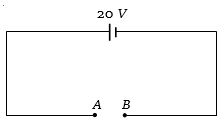
The potential difference between point $A$ and $B$ is ............. $V$
Easy
Download our app for free and get started
(d) The given circuit is a balanced wheatstone bridge circuit. Hence potential difference between $A$ and $B$ is zero.

Download our appand get started for free
Experience the future of education. Simply download our apps or reach out to us for more information. Let's shape the future of learning together!No signup needed.*
Similar Questions
- 1A metal wire has a resistance of $35 \,\Omega$. If its length is increased to double by drawing it, then its new resistance will be (in $\Omega$)View Solution
- 2There are two electric bulbs of $40\, W$ and $100\, W$. Which one will be brighter when first connected in series and then in parallel,View Solution
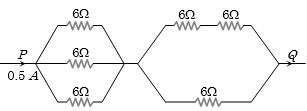
- 3Resistances of $6\, ohm$ each are connected in the manner shown in adjoining figure. With the current $0.5\,ampere$ as shown in figure, the potential difference ${V_P} - {V_Q}$ is .............. $V$View Solution
- 4The number density of free electrons in copper is nearly $8 \times 10^{28}\,m ^{-3} . A$ copper wire has its area of cross section $=2 \times 10^{-6}\,m ^2$ and is carrying a current of $3.2\,A$. The drift speed of the electrons is $.....\times 10^{-6}\,ms ^{-1}$.View Solution
- 5Consider a wire having current $10\,A$ having area of crossection $1\,cm^2$. If number of electrons per unit volume is $9 \times 10^{28}\, m^{-3}$. Find the drift velocity of electronsView Solution
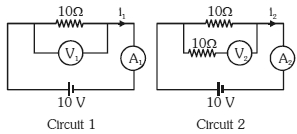
- 6View SolutionIn the circuits shown below, the readings of the voltmeters and the ammeters will be
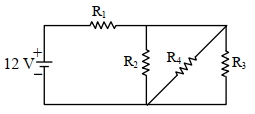
- 7In the given figure $R_1=10 \Omega, R_2=8 \Omega, R_3=4 \Omega$ and $R_4=8 \Omega$. Battery is ideal with emf $12 \mathrm{~V}$. Equivalent resistant of the circuit and current supplied by battery are respectively.View Solution
- 8In the shown circuit, what is the potential difference across $A$ and $B$ ......... $V$View Solution
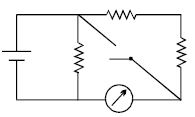
- 9In the circuit shown, the reading of the Ammeter is doubled after the switch is closed. Each resistor has a resistance $ = 1\,\Omega $ and the ideal cell has an $e.m.f. = 10\, V$. Then, the Ammeter has a coil resistance equal to ................ $\Omega$View Solution
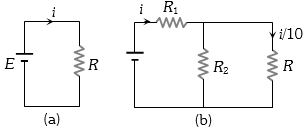
- 10Consider the circuits shown in the figure. Both the circuits are taking same current from battery but current through $R$ in the second circuit is $\frac{1}{{10}}$$^{th}$ of current through $R$ in the first circuit. If $R$ is $11$ $\Omega$, the value of $ R_1$ ................ $\Omega$View Solution