There are two electric bulbs of $40\, W$ and $100\, W$. Which one will be brighter when first connected in series and then in parallel,
Medium
Download our app for free and get started
(a) $\frac{{{R_1}}}{{{R_2}}} = \frac{{{P_2}}}{{{P_1}}} = \frac{{100}}{{40}} = \frac{5}{2}$. Resistance of $40\, W$ bulb is $\frac{5}{2}$ times than $100\, W$. In series, $P = {i^2}R$ and in parallel, $P = \frac{{{V^2}}}{R}$. So $40\, W$ in series and $100\, W$ in parallel will glow brighter.

Download our appand get started for free
Experience the future of education. Simply download our apps or reach out to us for more information. Let's shape the future of learning together!No signup needed.*
Similar Questions
- 1View SolutionThe drift velocity does not depend upon
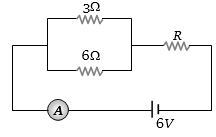
- 2If the ammeter in the given circuit reads $2\, A$, the resistance $R$ is ............ $ohm$View Solution
- 3When a potential difference $V$ is applied across a wire of resistance $R$, it dissipates energy at a rate $W$. If the wire is cut into two halves and these halves are connected mutually parallel across the same supply, the same supply, the energy dissipation rate will become:View Solution
- 4$12$ cells each having same $emf$ are connected in series with some cells wrongly connected. The arrangement is connected in series with an ammeter and two cells which are in series. Current is $3 \,A$ when cells and battery aid each other and is $2\, A$ when cells and battery oppose each other. The number of cells wrongly connected isView Solution
- 5A current of $1\, mA$ is flowing through a copper wire. How many electrons will pass a given point in one secondView Solution
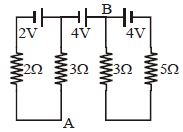
- 6In the given circuit calculate potential difference between $A$ and $B$ ............... $\mathrm{V}$View Solution
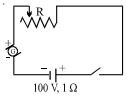
- 7The battery in the diagram is to be charged by the generator $G$. The generator has a terminal voltage of $120$ $\mathrm{volts}$ when the charging current is $10$ $\mathrm{amperes}.$ The battery has an $\mathrm{emf}$ of $100$ $\mathrm{volts}$ and an internal resistance of $1$ $\mathrm{ohm}.$ In order to charge the battery at $10$ $\mathrm{amperes}$ charging current, the resistance $R$ should be set at ................ $\Omega$View Solution
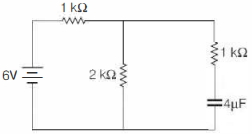
- 8The circuit shown has been connected for a long time. The voltage across the capacitor is ............. $V$View Solution
- 9How much energy in kilowatt hour is consumed in operating ten $50\, watt$ bulbs for $10$ hours per day in a month ($30$ days).View Solution
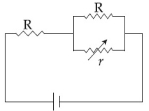
- 10In the circuit shown, the resistance $r$ is a variable resistance. If for $r = fR,$ the heat generation in $r$ is maximum then the value of $f$ isView Solution