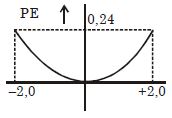
The potential energy of a particle with displacement $X$ is $U(X)$. The motion is simple harmonic, when ($K$ is a positive constant)
Easy


Download our appand get started for free
Experience the future of education. Simply download our apps or reach out to us for more information. Let's shape the future of learning together!No signup needed.*
Similar Questions
- 1Two masses $m_1$ and $m_2$ connected by a spring of spring constant $k$ rest on a frictionless surface. If the masses are pulled apart and let go, the time period of oscillation isView Solution
- 2The displacement of an oscillator is given by $x = a\, \sin \, \omega t + b\, \cos \, \omega t$. where $a, b$ and $\omega$ are constant. Then :-View Solution
- 3The motion of a mass on a spring, with spring constant ${K}$ is as shown in figure. The equation of motion is given by $x(t)= A sin \omega t+ Bcos\omega t$ with $\omega=\sqrt{\frac{K}{m}}$ Suppose that at time $t=0$, the position of mass is $x(0)$ and velocity $v(0)$, then its displacement can also be represented as $x(t)=C \cos (\omega t-\phi)$, where $C$ and $\phi$ areView Solution
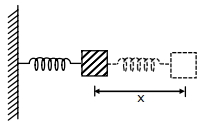
- 4$m x^{2}-b x+k=0$View Solution
Find time after which to the energy will become half of initial maximum value in damped force oscillation.
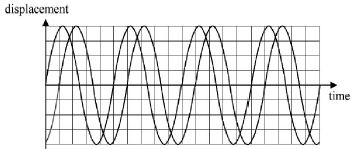
- 5View SolutionThe diagram shows two oscillations. What is the phase difference between the oscillations?
- 6When a particle of mass $m$ is attached to a vertical spring of spring constant $k$ and released, its motion is described by $y ( t )= y _{0} \sin ^{2} \omega t ,$ where $'y'$ is measured from the lower end of unstretched spring. Then $\omega$ isView Solution
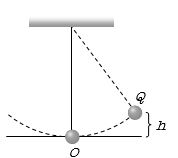
- 7The bob of a simple pendulum is displaced from its equilibrium position $O$ to a position $Q$ which is at height h above $O$ and the bob is then released. Assuming the mass of the bob to be $m$ and time period of oscillations to be $2.0\, sec$, the tension in the string when the bob passes through $O$ isView Solution
- 8A particle which is simultaneously subjected to two perpendicular simple harmonic motions represented by; $x = {a_1}\,\cos \,\omega t$ and $y = {a_2}\,\cos \,2\,\omega t$ traces a curve given byView Solution
- 9The displacement of an oscillator is given by $x = a\, \sin \, \omega t + b\, \cos \, \omega t$. where $a, b$ and $\omega$ are constant. Then :-View Solution
- 10A particle executing $S.H.M.$ its potential energy $V/S$ displacement graph is given by The value of restoring force constant is ..... $N/m$View Solution