When a particle of mass $m$ is attached to a vertical spring of spring constant $k$ and released, its motion is described by $y ( t )= y _{0} \sin ^{2} \omega t ,$ where $'y'$ is measured from the lower end of unstretched spring. Then $\omega$ is
JEE MAIN 2020, Diffcult
Download our app for free and get started
$y = y _{0} \sin ^{2} \omega t$
$y =\frac{ y _{0}}{2}(1-\cos 2 \omega t )$
$y -\frac{ y _{0}}{2}=-\frac{ y _{0}}{2} cos 2 \omega t$
Amplitude : $\frac{y_{0}}{2}$
$\frac{y_{0}}{2}=\frac{m g}{K}$
$2 \omega=\sqrt{\frac{K}{m}}=\sqrt{\frac{2 g}{y_{0}}}$
$\omega=\sqrt{\frac{g}{2 y_{0}}}$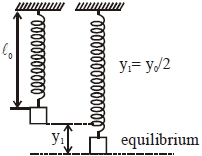

Download our appand get started for free
Experience the future of education. Simply download our apps or reach out to us for more information. Let's shape the future of learning together!No signup needed.*
Similar Questions
- 1View SolutionSelect wrong statement about simple,harmonic motion
- 2A circular disc of mass $10 \;kg$ is suspended by a wire attached to its centre. The wire is twisted by rotating the disc and released. The period of torsional oscillations is found to be $1.5 \;s$. The radius of the disc is $15\; cm .$ Determine the torsional spring constant of the wire in $N\;m\;rad^{-1}$. (Torsional spring constant $\alpha$ is defined by the relation $J=-\alpha \theta,$ where $J$ is the restoring couple and $\theta$ the angle of twist).View Solution
- 3A body of mass $m $ is attached to the lower end of a spring whose upper end is fixed. The spring has negligible mass. When the mass $m$ is slightly pulled down and released , it oscillates with a time period of $3\,s$ . When the mass $m$ is increased by $1\,kg$ , the time period of oscillations becomes $5\,s$ . The value of $m$ in $kg$ isView Solution
- 4If $x = a\sin \left( {\omega t + \frac{\pi }{6}} \right)$ and $x' = a\cos \omega t$, then what is the phase difference between the two wavesView Solution
- 5A particle is performing simple harmonic motion with amplitude A and angular velocity ${\omega }$. The ratio of maximum velocity to maximum acceleration isView Solution
- 6The amplitude of an oscillating simple pendulum is $10\,cm$ and its period is $4\, sec$. Its speed after $1\, sec$ after it passes its equilibrium position, is ... $m/s$View Solution
- 7A particle doing simple harmonic motion, amplitude $= 4\, cm$, time period $= 12\, sec$. The ratio between time taken by it in going from its mean position to $2 \,cm$ and from $2\, cm$ to extreme position isView Solution
- 8View SolutionA hollow sphere is filled with water through a small hole in it. It is then hung by a long thread and made to oscillate. As the water slowly flows out of the hole at the bottom, the period of oscillation will
- 9For a particle executing $S.H.M.,\, x =$ displacement from equilibrium position, $v =$ velocity at any instant and $a =$ acceleration at any instant, thenView Solution
- 10A block $P$ of mass $m$ is placed on a smooth horizontal surface. A block $Q$ of same mass is placed over the block $P$ and the coefficient of static friction between them is ${\mu _S}$. A spring of spring constant $K$ is attached to block $Q$. The blocks are displaced together to a distance $A$ and released. The upper block oscillates without slipping over the lower block. The maximum frictional force between the block isView Solution