The power of sound from the speaker of a radio is $20$ milli watt by turning the knob of the volume control the power of the sound is increased to $400$ milli watt. The power increase in decibles as compared to the original power is ..... $dB$
Medium


Download our appand get started for free
Experience the future of education. Simply download our apps or reach out to us for more information. Let's shape the future of learning together!No signup needed.*
Similar Questions
- 1Two vibrating tuning forks produce progressive waves given by $y_1= 4 \sin (500 \, \pi t)$ and $y_2= 2 \sin (506 \, \pi t)$. These tuning forks are held near the ear of a person. The person will hearView Solution
- 2The velocity of sound is $v_s$ in air. If the density of air is increased to $4$ times, then the new velocity of sound will beView Solution
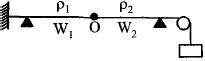
- 3Two wires $W_1$ and $W_2$ have the same radius $r$ and respective densities ${\rho _1}$ and ${\rho _2}$ such that ${\rho _2} = 4{\rho _1}$. They are joined together at the point $O$, as shown in the figure. The combination is used as a sonometer wire and kept under tension $T$. The point $O$ is midway between the two bridges. When a stationary waves is set up in the composite wire, the joint is found to be a node. The ratio of the number of an tin odes formed in $W_1$ to $W_2$ isView Solution
- 4A string is stretched between fixed points separated by $75.0\, cm$. It is observed to have resonant frequencies of $420\, Hz$ and $315\, Hz$. There are no other resonant frequencies between these two. Then, the lowest resonant frequency for this string is .... $Hz$View Solution
- 5The fundamental frequency of a sonometer wire of length $l$ is $n_0$ . A bridge is now introduced at a distance of $\Delta l ( < < l)$ from the centre of the wire. The lengths of wire on the two sides of the bridge are now vibrated in their fundamental modes. Then, the beat frequency nearly isView Solution
- 6The ratio of densities of nitrogen and oxygen is $14:16.$ The temperature at which the speed of sound in nitrogen will be same at that in oxygen at $55^oC$ is ..... $^oC$View Solution
- 7$Assertion :$ The base of Laplace correction was that exchange of heat between the region of compression and rarefaction in air is negligible.View Solution
$Reason :$ Air is bad conductor of heat and velocity of sound in air is quite large. - 8The first resonance length of a resonance tube is $40\,\, cm$ and the second resonance length is $122\,\, cm$. The third resonance length of the tube will be... $cm$View Solution
- 9Frequency of tuning fork $A$ is $256\,Hz$ . It produces four $beats/sec$ . with tuning fork $B$ . When wax is applied at tuning fork $B$ then $6\,beats/sec$ . are heard. By reducing little amount of wax $4\,beats/sec$ . are heard. Frequency of $B$ is .... $Hz$View Solution
- 10The intensity level due to two waves of the same frequency in a given medium are $1\, bel$ and $5\, bel$. Then the ratio of amplitudes isView Solution