Three bars having length $l, 2l$ and $3l$ and area of cross-section $A, 2 A$ and $3 A$ are joined rigidly end to end. Compound rod is subjected to a stretching force $F$. The increase in length of rod is (Young's modulus of material is $Y$ and bars are massless)
Easy


Download our appand get started for free
Experience the future of education. Simply download our apps or reach out to us for more information. Let's shape the future of learning together!No signup needed.*
Similar Questions
- 1View SolutionIf the length of a wire is reduced to half, then it can hold the ......... load
- 2Two wires $A$ and $B$ of same material have radii in the ratio $2: 1$ and lengths in the ratio $4: 1$. The ratio of the normal forces required to produce the same change in the lengths of these two wires is .......View Solution
- 3View SolutionThe following four wires are made of the same material. Which of these will have the largest extension when the same tension is applied?
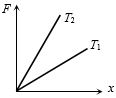
- 4The diagram shows the change $x$ in the length of a thin uniform wire caused by the application of stress $F$ at two different temperatures $T_1$ and $T_2$. The variations shown suggest thatView Solution
- 5View SolutionFour uniform wires of the same material are stretched by the same force. The dimensions of wire are as given below. The one which has the minimum elongation has
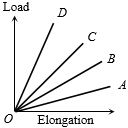
- 6View SolutionThe load versus elongation graph for four wires of the same material is shown in the figure. The thickest wire is represented by the line
- 7The work done in increasing the length of a metre long wire of cross-sectional area ........ $J.$ $1\,mm^2$ through $1\,mm$ will be $(Y = 2 \times 10^{11}\,Nm^{-2})$View Solution
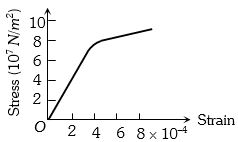
- 8Which one of the following is the Young’s modulus $($in $N/m^2)$ for the wire having the stress-strain curve shown in the figureView Solution
- 9A wire of length $5 m$ is twisted through $30^{\circ}$ at free end. If the radius of wire is $1\ mm$, the shearing strain in the wire is $..........$View Solution
- 10The ratio of Young's modulus of the material of two wires is $2 : 3.$ If the same stress is applied on both, then the ratio of elastic energy per unit volume will beView Solution