The ratio of diameters of two wires of same material is $n : 1$. The length of wires are $4\, m$ each. On applying the same load, the increase in length of thin wire will be
Medium
Download our app for free and get started
$1 \propto \frac{\mathrm{FL}}{\mathrm{r}^{2} \mathrm{Y}} \Rightarrow 1 \propto \frac{1}{\mathrm{r}^{2}}[\mathrm{F}, \mathrm{L} \text { and } \mathrm{Y} \text { are constant }]$
$\frac{1_{2}}{\mathrm{l}_{1}}=\left(\frac{\mathrm{r}_{1}}{\mathrm{r}_{2}}\right)^{2}=(\mathrm{n})^{2} \Rightarrow 1_{2}=\mathrm{n}^{2} \mathrm{l}_{1}$

Download our appand get started for free
Experience the future of education. Simply download our apps or reach out to us for more information. Let's shape the future of learning together!No signup needed.*
Similar Questions
- 1A uniformly tapering conical wire is made from a material of Young's modulus $Y$ and has a normal, unextended length $L.$ The radii, at the upper and lower ends of this conical wire, have values $R$ and $3R,$ respectively. The upper end of the wire is fixed to a rigid support and a mass $M$ is suspended from its lower end. The equilibrium extended length, of this wire, would equalView Solution
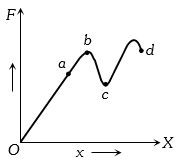
- 2The graph is drawn between the applied force $F$ and the strain $(x)$ for a thin uniform wire. The wire behaves as a liquid in the partView Solution
- 3A wire suspended vertically from one of its ends is stretched by attaching a weight of $200\, N$ to the lower end. The weight stretches the wire by $1\, mm$ Then the elastic energy stored in the wire is ........ $J$View Solution
- 4The length of an iron wire is $L$ and area of cross-section is $A$. The increase in length is $l$ on applying the force $F$ on its two ends. Which of the statement is correctView Solution
- 5A uniform rod of length $L$ has a mass per unit length $\lambda$ and area of cross-section $A$. If the Young's modulus of the rod is $Y$. Then elongation in the rod due to its own weight is ...........View Solution
- 6View SolutionThe material which practically does not show elastic after effect is
- 7Two wires $A$ and $B$ are of same materials. Their lengths are in the ratio $1 : 2$ and diameters are in the ratio $2 : 1$ when stretched by force ${F_A}$ and ${F_B}$ respectively they get equal increase in their lengths. Then the ratio ${F_A}/{F_B}$ should beView Solution
- 8Join details of Column$-II$ with given information in Column$-I$ appropriatelyView Solution
Column $-I$ Column $-II$ $(a)$ Stress is proportional to strain.
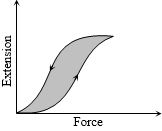
$(i)$ Elastic limit $(b)$ When the load of the wire is removed, the body does regain its original dimension. $(ii)$ Limit of pro-portionality $(iii)$ Plastic deformation - 9The diagram shows a force-extension graph for a rubber band. Consider the following statementsView Solution
$I.$ It will be easier to compress this rubber than expand it
$II.$ Rubber does not return to its original length after it is stretched
$III.$ The rubber band will get heated if it is stretched and released
Which of these can be deduced from the graph
- 10Given : $\sigma$ is the compressibility of water, $\rho$ is the density of water and $K$ is the bulk modulus of water. What is the energy density of water at the bottom of a lake $‘h’$ metre deep ?View Solution