MCQ
The ratio of specific heat of a mixture of one mole of helium and one mole of hydrogen gas will be
  • A
    $1$
  • $1.5$
  • C
    $1.53$
  • D
    $1.33$

Answer

Correct option: B.
$1.5$
b
${\gamma‌‌_{mix}} = \frac{{{n_1}{\gamma _1}({\gamma _2} - 1) + {n_2}{\gamma _2}({\gamma _1} - 1)}}{{{n_1}({\gamma _2} - 1) + {n_2}({\gamma _1} - 1)}}$

 $ = \frac{{\frac{5}{3}\left( {\frac{7}{5} - 1} \right) + \frac{7}{5}\left( {\frac{5}{3} - 1} \right)}}{{\left( {\frac{7}{5} - 1} \right) + \left( {\frac{5}{3} - 1} \right)}} = 1.5$

Need a full question paper?

Generate a complete, print-ready paper with questions like this in minutes — across 16+ boards, with answer keys.
Start Generating Free

Similar questions

If a particle moves from point $P (2,3,5)$ to point $Q (3,4,5)$. Its displacement vector be
An object is projected upwards with a velocity of $100 \,m/s$. It will strike the ground after (approximately)........$sec$
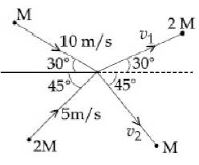
Two particles, of masses $M$ and $2M$, moving as shown, with speeds of $10\, m/s$ and $5\, m/s$, collide elastically at the origin. After the collision, they move along the indicated directions with speeds $v_1$ and $v_2$ respectively. The value of $v_1$ and $v_2$ are nearly
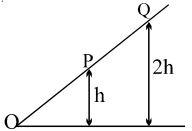
$A$ ball rolls down an inclined plane, figure. The ball is first released from rest from $P$ and then later from $Q$. Which of the following statement is/ are correct?

$(i)$ The ball takes twice as much time to roll from $Q$ to $O$ as it does to roll from $P$ to $O$.

$(ii)$ The acceleration of the ball at $Q$ is twice as large as the acceleration at $P$.

$(iii)$ The ball has twice as much $K.E$. at $O$ when rolling from $Q$ as it does when rolling from $P$.
When two bodies stick together after collision, the collision is said to be
Which of the following laws of thermodynamics defines the term internal energy?
Suppose a container ia evacuated to leave just one molecule of a gas in it. Let $\mathrm{V}_{\mathrm{a}}$ and $\mathrm{v}_{\mathrm{rms}}$ represent the average speed and the $\text{rms}$ speed of the gas.
With rise in temperature, the Young's modulus of elasticity
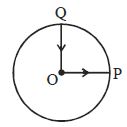
A cyclist starts from the centre $O$ of a circular park of radius one kilometre, reaches the edge $P$ of the partk. Then cycles along the circumference and returns to the centre along $QO$ as shown in the figure. If the round trip takes ten minutes, the net displacement and average speed of the cyclist (in metre and kilometre per hour respectively) is
If pressure of a gas contained in a closed vessel is increased by $0.4\%$ when heated by $1°C,$ the initial temperature must be