The ratio of total energy of all molecules of one mole $O_2$ to the total energy of all molecules of two moles of $He$ at the same temprature is
Medium


Download our appand get started for free
Experience the future of education. Simply download our apps or reach out to us for more information. Let's shape the future of learning together!No signup needed.*
Similar Questions
- 1One mole of an ideal gas passes through a process where pressure and volume obey the relation $P\, = {P_0}\,\left[ {1 - \frac{1}{2}{{\left( {\frac{{{V_0}}}{V}} \right)}^2}} \right]$. Here $P_0$ and $V_0$ are constants. Calculate the change in the temperature of the gas if its volume change from $V_0$ to $2V_0$View Solution
- 2View SolutionOn colliding in a closed container the gas molecules
- 3If $\alpha$ moles of a monoatomic gas are mixed with $\beta$ moles of a polyatomic gas and mixture behaves like diatomic gas, then [neglect the vibrational mode of freedom]View Solution
- 4The mean free path for a gas, with molecular diameter $d$ and number density $n$ can be expressed as :View Solution
- 5A spherical bubble inside water has radius $R$. Take the pressure inside the bubble and the water pressure to be $p_0$. The bubble now gets compressed radially in an adiabatic manner so that its radius becomes $(R-a)$. For $a \ll R$ the magnitude of the work done in the process is given by $\left(4 \pi p_0 R a^2\right) X$, where $X$ is a constant and $\gamma=C_p / C_V=41 / 30$. The value of $X$ is. . . . . .View Solution
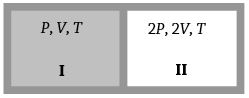
- 6A partition divides a container having insulated walls into two compartments $I$ and $II$. the same gas fills the two compartments. The ratio of the number of molecules in compartments $I$ and $II$ isView Solution
- 7View SolutionSelect the incorrect statement about ideal gas.
- 8An inverted bell lying at the bottom of a lake $47.6\,m$ deep has $50\, cm^3$ of air trapped in it. The bell is brought to the surface of the lake. The volume of the trapped air will be ...... $cm^3$ (atmospheric pressure $= 70\, cm$ of $Hg$ and density of $Hg = 13.6\, g/cm^3$)View Solution
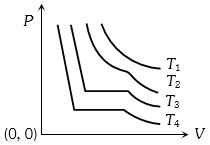
- 9The change in volume $V$ with respect to an increase in pressure $P$ has been shown in the figure for a non-ideal gas at four different temperatures ${T_1},\,{T_2},\,{T_3}$ and ${T_4}$. The critical temperature of the gas isView Solution
- 10View SolutionThe kinetic energy per gm mol for a diatomic gas at room temperature is