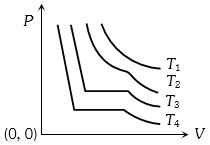
The change in volume $V$ with respect to an increase in pressure $P$ has been shown in the figure for a non-ideal gas at four different temperatures ${T_1},\,{T_2},\,{T_3}$ and ${T_4}$. The critical temperature of the gas is
Medium


Download our appand get started for free
Experience the future of education. Simply download our apps or reach out to us for more information. Let's shape the future of learning together!No signup needed.*
Similar Questions
- 1Energy of $10$ non rigid diatomic molecules at temperature $\mathrm{T}$ is :View Solution
- 2View SolutionVolume of gas become four times if
- 3An ideal gas initially at pressure $1$ bar is being compressed from $30 \,m ^{3}$ to $10\, m ^{3}$ volume and its temperature decreases from $320\, K$ to $280\, K$. then find final pressure of gas (in bar)View Solution
- 4The temperature of $5$ moles of a gas which was held at constant volume was changed from ${100^o}C$ to ${120^o}C$. The change in internal energy was found to be $80$ Joules. The total heat capacity of the gas at constant volume will be equal to ...... $J/K$View Solution
- 5The temperature, at which the root mean square velocity of hydrogen molecules equals their escape velocity from the earth is closest to : [Boltzmans Constant $k_B = 1.38\times10^{-23}\, J / K$ Avogadro number $N_A = 6.02\times10^{26}\, / kg$ Radius of Earth $: 6.4\times10^6\, m$ Gravitation acceleration on Earth $= 10\, ms^{-2}$]View Solution
- 6The air density at Mount Everest is less than that at the sea level. It is found by mountaineers that for one trip lasting a few hours, the extra oxygen needed by them corresponds to $30,000\ cc$ at sea level (pressure $1$ atmosphere, temperature $27^oC).$ Assuming that the temperature around Mount Everest is $-73^oC$ and that the oxygen cylinder has capacity of $5.2\ litre,$ the pressure at which $O_2$ be filled (at site) in cylinder is ..... $atm$View Solution
- 7The volume of a gas will be double of what it is at $0°C$ (pressure remaining constant) atView Solution
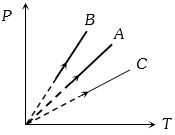
- 8Pressure versus temperature graph of an ideal gas at constant volume $V$ of an ideal gas is shown by the straight line $A$. Now mass of the gas is doubled and the volume is halved, then the corresponding pressure versus temperature graph will be shown by the lineView Solution
- 9$7$ mole of certain monoatomic ideal gas undergoes a temperature increase of $40 K$ at constant pressure. The increase in the internal energy of the gas in this process is$....J$ (Given $R =8.3 JK ^{-1} mol ^{-1}$ )View Solution
- 10The specific heat of a gas at constant volume is $21.2\, J/mole/°C.$ If the temperature is increased by $1°C$ keeping the volume constant, the change in its internal energy will be ...... $J$View Solution