The relation between root mean square speed $\left( v _{ rms }\right)$ and most probable speed $\left( v _{ p }\right)$ for the molar mass $M$ of oxygen gas molecule at the temperature of $300\, K$ will be
JEE MAIN 2022, Medium


Download our appand get started for free
Experience the future of education. Simply download our apps or reach out to us for more information. Let's shape the future of learning together!No signup needed.*
Similar Questions
- 1The equation for an ideal gas is $PV = RT,$ where $V$ represents the volume ofView Solution
- 2Three closed vessels $A, B$ and $C$ are at the same temperature $T$ and contain gases which obey the Maxwellian distribution of velocities. Vessel $A$ contains only ${O_2},\,B$ only ${N_2}$ and $C$ a mixture of equal quantities of ${O_2}$ and ${N_2}$. If the average speed of the ${O_2}$ molecules in vessel A is ${V_1}$, that of the ${N_2}$ molecules in vessel B is ${V_2}$, the average speed of the ${O_2}$ molecules in vessel $C$ isView Solution
- 3Five moles of helium are mixed with two moles of hydrogen to form a mixture. Take molar mass of helium $M_1=4\ g$ and that of hydrogen $M_2=2\ g$ The equivalent degree of freedom $f$ of the mixture isView Solution
- 4A monoatomic gas performs a work of $\frac{Q}{4}$ where $Q$ is the heat supplied to it. The molar heat capaticy of the gas will be $R$ during this transformation. Where $R$ is the gas constant.View Solution
- 5What is the value of $\frac{R}{{{C_P}}}$ for diatomic gasView Solution
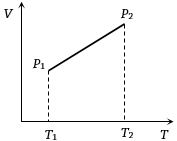
- 6From the following $V-T$ diagram we can concludeView Solution
- 7View SolutionMoon has no atmosphere because
- 8A cylinder containing gas at $27\,^oC$ is divided into two parts of equal volume each $100\,^oc$ and at equal pressure by a piston of cross sectional area $10.85\,\, cm^2$. The gas in one part is raised in temperature to $100\,^oC$ while the other maintained at original temperature. The piston and wall are perfect insulators. How far will the piston move during the change in temperature.... $cm$ .View Solution
- 9The respective speeds of the molecules are $1, 2, 3, 4$ and $5\, km/sec.$ The ratio of their $r.m.s. $ velocity and the average velocity will beView Solution
- 10View SolutionIndicator diagram is a ...........