MCQ
The relation between the vectors A and -2A is that,
  • A
    Both have same magnitude.
  • B
    Both have same direction.
  • C
    They have opposite directions.
  • D
    None of the above.

Answer

  1. They have opposite directions.

Explanation:

Multiplying a vector A by a negative number $\lambda$ gives a vector $\lambda\text{A},$ whose directions opposite to the direction of A and it's magnitude is $-\lambda$ times |A|.

Need a full question paper?

Generate a complete, print-ready paper with questions like this in minutes — across 16+ boards, with answer keys.
Start Generating Free

Similar questions

A disc and a ring of same mass are rolling and if their kinetic energies are equal, then the ratio of their velocities will be
The length of a rod is $(11.05\pm0.05)\text{cm}.$ What is the total length of 2 such rods?
At a given place where acceleration due to gravity is $‘g’$ $m/{\sec ^2}$, a sphere of lead of density $‘d’$ $kg/{m^3}$ is gently released in a column of liquid of density $'\rho '\;kg/{m^3}$. If $d > \rho $, the sphere will
Dimensional formula for torque is
A block of mass $1 \,kg$ slides down on a rough inclined plane of inclination $60^°$ starting from its top. If the coefficient of kinetic friction is $0.5$ and length of the plane is $1 \,m$, then work done against friction is ........ $J$
If the mass of the bob in a simple pendulum is increased to thrice its original mass and its length is made half its original length, then the new time period of oscillation is $\frac{x}{2}$ times its original time period. Then the value of $x$ is:
The density of ice is $0.9 \,g / cm ^3$. What percentage by volume of the block of ice floats outside the water is ..........$\%$
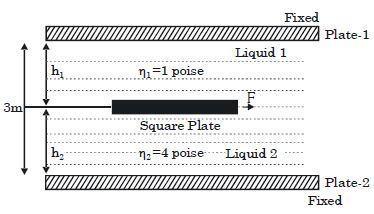
A thin square plate of side $2\ m$ is moving at the interface of two very viscous liquids of viscosities ${\eta _1} = 1$ poise and ${\eta _2} = 4$ poise respectively as shown in the figure. Assume a linear velocity distribution in each fluid. The liquids are contained between two fixed plates. $h_1 + h_2 = 3\ m$ . A force $F$ is required to move the square plate with uniform velocity $10\ m/s$ horizontally then the value of minimum applied force will be ........ $N$
Which of the following displacement $(X)$ time graphs is not possible?
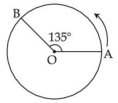
A person moved from $A$ to $B$ on a circular path as shown in figure. If the distance travelled by him is $60 \,m$, then the magnitude of displacement would be$.....\,m$ (Given $\left.\cos 135^{\circ}=-0.7\right)$