The r.m.s. speed of a group of $7$ gas molecules having speeds $(6, 4, 2, 0, -2, -4, -6)\, m/s$ is ...... $m/s$
Medium


Download our appand get started for free
Experience the future of education. Simply download our apps or reach out to us for more information. Let's shape the future of learning together!No signup needed.*
Similar Questions
- 1During an adiabatic process, the pressure of a gas is found to be proportional to the cube of its absolute temperature. The ratio of $\frac{C_p}{C_v}$ for the gas is:View Solution
- 2The pressure $P,$ volume $V$ and temperature $T$ of a gas in the jar $A$ and the other gas in the jar $B$ at pressure $2P,$ volume $V/4$ and temperature $2T,$ then the ratio of the number of molecules in the jar $A$ and $B$ will beView Solution
- 3If $c_V$ and $c_V$ denote the specific heats (per unit) mass of an ideal gas of molecular weight $M$, thenView Solution
where $R$ is the molar gas constant.
- 4$P-V$ diagram of a diatomic gas is a straight line passing through origin. The molar heat capacity of the gas in the process will beView Solution
- 5A diatomic gas of molecular mass $40 \,g / mol$ is filled in a rigid container at temperature $30^{\circ} C$. It is moving with velocity $200 \,m / s$. If it is suddenly stopped, the rise in the temperature of the gas is .........View Solution
- 6The specific heats, $C_P$ and $C_V$ of a gas of diatomic molecules, $A$, are given (in units of $J\, mol^{-1}\, K^{-1}$) by $29$ and $22$, respectively. Another gas of diatomic molecules $B$, has the corresponding values $30$ and $21$. If they are treated as ideal gases, thenView Solution
- 7$125\, ml$ of gas $A$ at $0.60$ atmosphere and $150\, ml$ of gas $B$ at $0.80$ atmosphere pressure at same temperature is filled in a vessel of $1$ litre volume. What will be the total pressure of mixture at the same temperature ............... $\mathrm{atmosphere}$View Solution
- 8$50 \,cal$ of heat is required to raise the temperature of $1$ mole of an ideal gas from $20^{\circ} C$ to $25^{\circ} C$, while the pressure of the gas is kept constant. The amount of heat required to raise the temperature of the same gas through same temperature range at constant volume is ........ $cal$ $(R=2 \,cal / mol -K )$View Solution
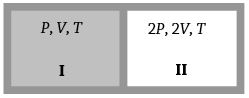
- 9A partition divides a container having insulated walls into two compartments $I$ and $II$. the same gas fills the two compartments. The ratio of the number of molecules in compartments $I$ and $II$ isView Solution
- 10For a gas, the $r.m.s.$ speed at $800\, K$ isView Solution