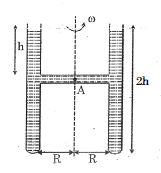
The shown $H$ shaped apparatus contains an ideal incompressible liquid and has dimension as shown in figure . The diameters of the Tubes are small as compared to $h$ and $R$. The apparatus is rotated with a constant angular velocity $\omega$ about a symmetric vertical axis as shown in figure. The pressure at point $A$ is
Diffcult
Download our app for free and get started
Due to rotation of system, height $'h'$ will
not change in capillary.
So, $P_{A}=P_{B}-\frac{\rho \omega^{2} R^{2}}{2}=P_{0}+\rho g h-\frac{\rho \omega^{2} R^{2}}{2}$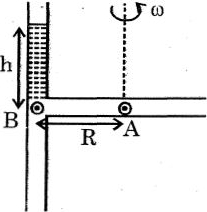

Download our appand get started for free
Experience the future of education. Simply download our apps or reach out to us for more information. Let's shape the future of learning together!No signup needed.*
Similar Questions
- 1$Assertion :$ For Reynold’s number $Re > 2000$, the flow of fluid is turbulent.View Solution
$Reason :$ Inertial forces are dominant compared to the viscous forces at such high Reynold’s numbers. - 2Two small spherical metal balls, having equal masses, are made from materials of densities $\rho_{1}$ and $\rho_{2}\left(\rho_{1}=8 \rho_{2}\right)$ and have radii of $1\; \mathrm{mm}$ and $2\; \mathrm{mm}$, respectively. They are made to fall vertically (from rest) in a viscous medum whose coefficient of viscosity equals $\eta$ and whose denstry is $0.1 \mathrm{\rho}_{2} .$ The ratio of their terminal velocitites would beView Solution
- 3A cubical block of wood of edge $10$ $cm$ and mass $0.92$ $kg$ floats on a tank of water with oil of rel. density $0.6$ to a depth of $4$ $cm$ above water. When the block attains equilibrium with four of its sides edges verticalView Solution
- 4A small drop of water falls from rest through a large height $h$ in air; the final velocity isView Solution
- 5$Assertion :$ Falling raindrops acquire a terminal velocity.View Solution
$Reason :$ A constant force in the direction of motion and a velocity dependent force opposite to the direction of motion, always result in the acquisition of terminal velocity. - 6An object suspended by a wire stretches it by $10 \,mm$. When object is immersed in a liquid the elongation in wire reduces by $\frac{10}{3} \,mm$. The ratio of relative densities of the object and liquid is ............View Solution
- 7A tank $5 \,m$ high is half filled with water and then is filled to the top with oil of density $0.85 \,g/cm^3$. The pressure at the bottom of the tank, due to these liquids is ........ $g/cm^2$View Solution
- 8The pressure acting on a submarine is $3 \times 10^{5}\;Pa$ at a certain depth. If the depth is doubled, the percentage increase in the pressure acting on the submarine would be: (Assume that atmospheric pressure is $1 \times 10^{5} \;Pa$ density of water is $10^{3}\, kg \,m ^{-3}, g =10 \,ms ^{-2}$ )View Solution
- 9View SolutionA cork is submerged in water by a spring attached to the bottom of a bowl. When the bowl is kept in an elevator moving with acceleration downwards, the length of spring
- 10A pump draws water from a tank which is at $2.5\; m$ down from outlet and issues it from the end of a hose which the water is drawn. The cross sectional area is $10\; cm ^{2}$, and the water leaves the end of the hose at a speed of $5\; m / s$. What is the rate at which the pump is working ?View Solution