The specific heat at constant pressure and at constant volume for an ideal gas are ${C_p}$ and ${C_v}$ and its adiabatic and isothermal elasticities are ${E_\varphi }$ and ${E_\theta }$ respectively. The ratio of ${E_\varphi }$ to ${E_\theta }$ is
Easy


Download our appand get started for free
Experience the future of education. Simply download our apps or reach out to us for more information. Let's shape the future of learning together!No signup needed.*
Similar Questions
- 1A wire can be broken by applying a load of $20\,\,kg$ weight. The force required to break the wire of twice the diameter is ......... $kg\,wt$View Solution
- 2If the compressibility of water is $\sigma $ per unit atmospheric pressure, then the decrease in volume $V$ due to $P$ atmospheric pressure will beView Solution
- 3View SolutionWhich of the following statements is correct
- 4An elastic material of Young's modulus $Y$ is subjected to a stress $S$. The elastic energy stored per unit volume of the material isView Solution
- 5Young's modules of material of a wire of length ' $L$ ' and cross-sectional area $A$ is $Y$. If the length of the wire is doubled and cross-sectional area is halved then Young's $modules$ will be :View Solution
- 6View SolutionIf the temperature increases, the modulus of elasticity
- 7Young's moduli of the material of wires $A$ and $B$ are in the ratio of $1: 4$, while its area of cross sections are in the ratio of $1: 3$. If the same amount of load is applied to both the wires, the amount of elongation produced in the wires $A$ and $B$ will be in the ratio ofView Solution
[Assume length of wires $A$ and $B$ are same]
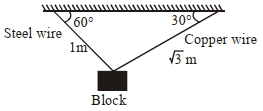
- 8A block of weight $100 N$ is suspended by copper and steel wires of same cross sectional area $0.5 cm ^2$ and, length $\sqrt{3} m$ and $1 m$, respectively. Their other ends are fixed on a ceiling as shown in figure. The angles subtended by copper and steel wires with ceiling are $30^{\circ}$ and $60^{\circ}$, respectively. If elongation in copper wire is $\left(\Delta \ell_{ C }\right)$ and elongation in steel wire is $\left(\Delta \ell_{ s }\right)$, then the ratio $\frac{\Delta \ell_{ C }}{\Delta \ell_{ S }}$ is. . . . . .View Solution
[Young's modulus for copper and steel are $1 \times 10^{11} N / m ^2$ and $2 \times 10^{11} N / m ^2$ respectively]
- 9A material has Poisson's ratio $0.5$. If a uniform rod of it suffers a longitudinal strain of $3 \times 10^{-3}$, what will be percentage increase in volume is .......... $\%$View Solution
- 10The bulk modulus of a gas is defined as $B=-V d p / d V$. For an adiabatic process the variation of $B$ is proportional to $p^n$. For an ideal gas $n$ isView Solution