MCQ
The specific heat of isothermal process is
  • A
    $0$
  • $\infty $
  • C
    $\frac{3}{2}\,R$
  • D
    $\frac{5}{2}\,R$

Answer

Correct option: B.
$\infty $
b
Given the process is isothermal which means it's temperature won't increase.

$C _p=\frac{\Delta Q }{ n \Delta T }$

Therefore specific heat will be infinity, as it is defined as heat supplied per unit increase in temperature.

Need a full question paper?

Generate a complete, print-ready paper with questions like this in minutes — across 16+ boards, with answer keys.

Start Generating Free

Similar questions

An oxide coated filament is useful in vacuum tubes because essentially
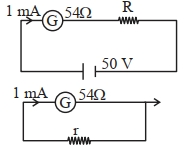
For designing a voltmeter of range $50\,V$ and an ammeter of range $10\,mA$ using a galvanometer which has a coil of resistance $54\,\Omega$ showing a full scale deflection for $1\,mA$ as in figure.

$(A)$ for voltmeter $R \approx 50\,k\Omega$

$(B)$ for ammeter $r \approx 0.2\,\Omega$

$(C)$ for ammeter $r \approx 6\,\Omega$

$(D)$ for voltmeter $R \approx 5\,k \Omega$

$(E)$ for voltmeter $R \approx 500 \Omega$

Choose the correct answer from the options given below
Given below are two statements: one is labelled as Assertion $A$ and the other is labelled as Reason $R$.

Assertion $A$: The potential ( $V$ ) at any axial point, at $2 \mathrm{~m}$ distance ( $r$ ) from the centre of the dipole of dipole moment vector $\vec{P}$ of magnitude, $4 \times 10^{-6} \mathrm{C} \mathrm{m}$, is $\pm 9 \times 10^3 \mathrm{~V}$.

(Take $\frac{1}{4 \pi \epsilon_0}=9 \times 10^9 \mathrm{Sl}$ units)

Reason $R$: $V= \pm \frac{2 P}{4 \pi \epsilon_0 r^2}$, where $r$ is the distance of any axial point, situated at $2 \mathrm{~m}$ from the centre of the dipole.

In the light of the above statements, choose the correct answer from the options given below:

Consider the following statements :
A. The junction area of solar cell is made very narrow compared to a photo diode.
B. Solar cells are not connected with any external bias.
C. LED is made of lightly doped p-n junction.
D. Increase of forward current results in continuous increase of LED light intensity.
E. LEDs have to be connected in forward bias for emission of light.
If a $30\, V$, $90\, W$ bulb is to be worked on a $120\, V$ line, a resistance of how many ohms should be connected in series with the bulb ............... $ohm$
A submarine experiences a pressure of $5.05\times 10^6\,Pa$ at a depth of $d_1$ in a sea. When it goes further to a depth of $d_2,$ it experiences a pressure of $8.08\times 10^6\,Pa.$ Then $d_2 -d_1$ is approximately ........ $m$ (density of water $= 10^3\,kg/m^3$ and acceleration due to gravity $= 10\,ms^{-2}$ )
In materials like aluminium and copper, the correct order of magnitude of various elastic modulii is 
The ends of a rope are held by two men who pulls on it with equal and opposite forces of  magnitude $F$ each. Then the tension in the rope is 
A long straight wire carries a current along the $x$-axis. Consider the points $A(0, 1, 0), B(0, 1, 1), C(1, 0, 1)$ and $D(1, 1, 1)$. Which of the following pairs of points will have magnetic fields of the same magnitude?
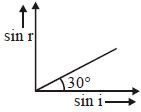
When light is incident on a medium at angle $i$ and refracted into a second medium at an angale $r,$ the graph of $\sin i$ vs $\sin r$ is as shown in the graph. From this, one can conclude that is as shown in the graph. From this, one can conclude that :-

$(a)$ Velocity of light in the second medium is $1.73$ times the velocity of light in the $I$ medium

$(b)$ Velocity of light in the $I$ medium is $1.73$ times the velocity in the $II$ medium

$(c)$ The critical angle for the two media is given by $\sin \,{i_c}\, = \,\frac{1}{{\sqrt 3 }}$

$(d)$ $\sin \,{i_c}\, = \,\frac{1}{2}$