The temperature of an ideal gas is reduced from $927^\circ C$ to $27^\circ C$. The $r.m.s.$ velocity of the molecules becomes
Easy


Download our appand get started for free
Experience the future of education. Simply download our apps or reach out to us for more information. Let's shape the future of learning together!No signup needed.*
Similar Questions
- 1The curve between absolute temperature and ${v^2}_{rms}$ isView Solution
- 2An ideal gas is initially at temperature $T$ and volume $V.$ Its volume is increased by $\Delta V$ due to an increase in temperature $\Delta T,$ pressure remaining constant. The quantity $\delta = \Delta V/(V\Delta T)$ varies with temperature asView Solution
- 3A certain amount of an ideal monatomic gas needs $20 \,J$ of heat energy to raise its temperature by $10^{\circ} C$ at constant pressure. The heat needed for the same temperature rise at constant volume will be ........ $J$View Solution
- 4The velocity of the molecules of a gas at temperature $120\,K$ is $v$. At ...... $K$ temperature will the velocity be $2v$View Solution
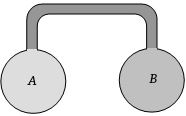
- 5Two spherical vessel of equal volume, are connected by a n arrow tube. The apparatus contains an ideal gas at one atmosphere and $300K$. Now if one vessel is immersed in a bath of constant temperature $600K$ and the other in a bath of constant temperature $300K$. Then the common pressure will be ...... $atm$View Solution
- 6A container is divided into two chambers by a partition. The volume of first chamber is $4.5$ litre and second chamber is $5.5$ litre. The first chamber contain $3.0$ moles of gas at pressure $2.0\, atm$ and second chamber contain $4.0$ moles of gas at pressure $3.0\, atm$ .After the partition is removed and the mixture attains equilibrium, then, the common equilibrium pressure existing in the mixture is $x \times 10^{-1} atm$. Value of $x$ is.........View Solution
- 7The temperature at which the kinetic energy of oxygen molecules becomes double than its value at $27^{\circ}\,C$ is $............^{\circ}\,C$View Solution
- 8At a given temperature, the pressure of an ideal gas of density $\rho $ is proportional toView Solution
- 9An ideal gas has an initial pressure of $3$ pressure units and an initial volume of $4$ volume units. The table gives the final pressure and volume of the gas (in those same units) in four, processes. Which processes start and end on the same isothermView Solution
$\begin{array}{|c|c|c|c|c|} \hline & A & B & C & D \\ \hline P & 5 & 4 & 12 & 6 \\ \hline V & 7 & 6 & 1 & 3 \\ \hline \end{array}$
- 10An air bubble of volume $1.0\; cm ^{3}$ rises from the bottom of a lake $40\; m$ deep at a temperature of $12\,^{\circ} C$. To what volume (in $cm^3$) does it grow when it reaches the surface, which is at a temperature of $35\,^{\circ} C ?$View Solution