The terminal velocity of a copper ball of radius $2.0 \;mm$ falling through a tank of oll at $20\,^{\circ} C$ is $6.5 \;cm s ^{-1} .$ Compute the viscosity of the oil at $20\,^{\circ} C .$ Density of oil is $1.5 \times 10^{3} \;kg m ^{-3},$ density of copper is $8.9 \times 10^{3} \;kg m ^{-3}$
Easy


Download our appand get started for free
Experience the future of education. Simply download our apps or reach out to us for more information. Let's shape the future of learning together!No signup needed.*
Similar Questions
- 1A nurse measures the blood pressure of a seated patient to be $190 \,mm$ of $Hg$.View Solution
- 2Water is flowing through a horizontal tube having cross-sectional areas of its two ends being $A$ and $A'$ such that the ratio $A/A'$ is $5$ છે.જો If the pressure difference of water between the two ends is $3 \times 10^5\, N\, m^{-2}$, the velocity of water with which it enters the tube will be ......... $m s^{-1}$ (neglect gravity effects)View Solution
- 3A rectangular block is $5 cm × 5 cm × 10cm$ in size. The block is floating in water with $ 5 cm $ side vertical. If it floats with $10 cm $ side vertical, what change will occur in the level of water?View Solution
- 4An open glass tube is immersed in mercury in such a way that a length of $8\ cm$ extends above the mercury level. The open end of the tube is then closed and sealed and the tube is raised vertically up by additional $46\ cm$. What will be length of the air column above mercury in the tube now ....... $cm$ ?View Solution
( Atmospheric pressure = $76\ cm$ of $Hg$)
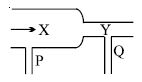
- 5A steady flow of water passes along a horizontal tube from a wide section $X$ to the narrower section $Y$, see figure. Manometers are placed at $P$ and $Q$ at the sections. Which of the statements $A, B, C, D, E$ is most correct?View Solution
- 6A ball rises to surface at a constant velocity in a liquid whose density is $4$ times greater than that of the material of the ball. The ratio of the force of friction acting on the rising ball and its weight isView Solution
- 7View SolutionAn open cubical tank was initially fully filled with water. When the tank was accelerated on a horizontal plane along one of its side it was found that one third of volume of water spilled out. The acceleration was
- 8$Assertion :$ Falling raindrops acquire a terminal velocity.View Solution
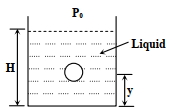
$Reason :$ A constant force in the direction of motion and a velocity dependent force opposite to the direction of motion, always result in the acquisition of terminal velocity. - 9A small spherical monoatomic ideal gas bubble $\left(\gamma=\frac{5}{3}\right)$ is trapped inside a liquid of density $\rho_{\ell}$ (see figure). Assume that the bubble does not exchange any heat with the liquid. The bubble contains n moles of gas. The temperature of the gas when the bubble is at the bottom is $\mathrm{T}_0$, the height of the liquid is $\mathrm{H}$ and the atmospheric pressure is $\mathrm{P}_0$ (Neglect surface tension).View Solution
Figure: $Image$
$1.$ As the bubble moves upwards, besides the buoyancy force the following forces are acting on it
$(A)$ Only the force of gravity
$(B)$ The force due to gravity and the force due to the pressure of the liquid
$(C)$ The force due to gravity, the force due to the pressure of the liquid and the force due to viscosity of the liquid
$(D)$ The force due to gravity and the force due to viscosity of the liquid
$2.$ When the gas bubble is at a height $\mathrm{y}$ from the bottom, its temperature is
$(A)$ $\mathrm{T}_0\left(\frac{\mathrm{P}_0+\rho_0 \mathrm{gH}}{\mathrm{P}_0+\rho_t \mathrm{gy}}\right)^{2 / 5}$
$(B)$ $T_0\left(\frac{P_0+\rho_t g(H-y)}{P_0+\rho_t g H}\right)^{2 / 5}$
$(C)$ $\mathrm{T}_0\left(\frac{\mathrm{P}_0+\rho_t \mathrm{gH}}{\mathrm{P}_0+\rho_t \mathrm{gy}}\right)^{3 / 5}$
$(D)$ $T_0\left(\frac{P_0+\rho_t g(H-y)}{P_0+\rho_t g H}\right)^{3 / 5}$
$3.$ The buoyancy force acting on the gas bubble is (Assume $R$ is the universal gas constant)
$(A)$ $\rho_t \mathrm{nRgT}_0 \frac{\left(\mathrm{P}_0+\rho_t \mathrm{gH}\right)^{2 / 5}}{\left(\mathrm{P}_0+\rho_t \mathrm{gy}\right)^{7 / 5}}$
$(B)$ $\frac{\rho_{\ell} \mathrm{nRgT}_0}{\left(\mathrm{P}_0+\rho_{\ell} \mathrm{gH}\right)^{2 / 5}\left[\mathrm{P}_0+\rho_{\ell} \mathrm{g}(\mathrm{H}-\mathrm{y})\right]^{3 / 5}}$
$(C)$ $\rho_t \mathrm{nRgT} \frac{\left(\mathrm{P}_0+\rho_t g \mathrm{H}\right)^{3 / 5}}{\left(\mathrm{P}_0+\rho_t g \mathrm{~g}\right)^{8 / 5}}$
$(D)$ $\frac{\rho_{\ell} \mathrm{nRgT}_0}{\left(\mathrm{P}_0+\rho_{\ell} \mathrm{gH}\right)^{3 / 5}\left[\mathrm{P}_0+\rho_t \mathrm{~g}(\mathrm{H}-\mathrm{y})\right]^{2 / 5}}$
Give the answer question $1,2,$ and $3.$
- 10A barometer kept in an elevator reads $76 \,cm$ when the elevator is accelerating upwards. The most likely pressure inside the elevator (in $cm$ of $Hg$ ) is ........View Solution