MCQ
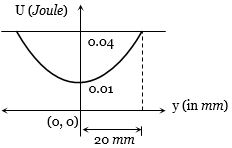
The variation of potential energy of harmonic oscillator is as shown in figure. The spring constant is
  • A
    $1 \times 10^2 N/m$
  • $150 N/m$
  • C
    $0.667 \times 10^2 N/m$
  • D
    $3 \times 10^2 N/m$

Answer

Correct option: B.
$150 N/m$
b
(b)Total potential energy $= 0.04 J$
Resting potential energy $=0.01 J$
Maximum kinetic energy $=(0.04-0.01)$
$ = 0.03J = \frac{1}{2}m\;{\omega ^2}{a^2} = \frac{1}{2}k{a^2}$
$0.03 = \frac{1}{2} \times k \times {\left( {\frac{{20}}{{1000}}} \right)^2}$
$k = 0.06 \times 2500\;N/m = 150\;N/m$.

Need a full question paper?

Generate a complete, print-ready paper with questions like this in minutes — across 16+ boards, with answer keys.

Start Generating Free

Similar questions

Which statements are correct about degrees of freedom?

$A.$ $A$ molecule with $n$ degrees of freedom has $n^{2}$ different ways of storing energy.

$B.$ Each degree of freedom is associated with $\frac{1}{2} RT$ average energy per mole.

$C.$ $A$ monoatomic gas molecule has $1$ rotational degree of freedom where as diatomic molecule has $2$ rotational degrees of freedom

$D$ $CH _{4}$ has a total to $6$ degrees of freedom Choose the correct answer from the option given below:
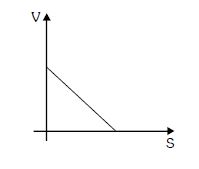
Velocity-displacement graph of a particle moving in a straight line is as shown in figure
A particle $B$ is moving in a circle of radius $a$ with a uniform speed $u$. $C$ is the centre of the circle and $AB$ is diameter. The angular velocity of $B$ about $A$ and $C$ are in the  ratio
A body of mass $2 \,kg$ is projected vertically upwards with a velocity of $2\,m\,{\sec ^{ - 1}}$. The K.E. of the body just before striking the ground is ............. $\mathrm{J}$
A copper block of mass $5.0\, kg$ is heated to a temperature of $500^{\circ} C$ and is placed on a large ice block. What is the maximum amount of ice (ઇન $kg$) that can melt? [Specific heat of copper: $0.39\, Jg ^{-1 \circ} C ^{-1}$ and latent heat of fusion of water : $335 \,J g ^{-1}$ ]
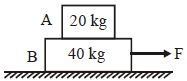
In figure, the coefficient of friction between the floor and the block $B$ is $0.2$ and  between blocks $A$ and $B$ is $0.3$. ........ $N$  is the maximum horizontal force $F$ can be  applied to the block $B$ so that both blocks move together .
A cork is submerged in water by a spring attached to the bottom of a pail. When the pail is kept in a elevator moving with an acceleration downwards, the spring length
The temperature of a wire of length $1$ metre and area of cross-section $1\,c{m^2}$ is increased from $0°C$ to $100°C$. If the rod is not allowed to increase in length, the force required will be $(\alpha = {10^{ - 5}}/^\circ C$ and $Y = {10^{11}}\,N/{m^2})$
The $K.E.$ and $P.E.$ of a particle executing $SHM$ with amplitude $A$ will be equal when its displacement is-
Two periodic waves of amplitudes $A_1$ and $A_2$ pass through a region. If $A_1>A_2$, the difference in the maximum and minimum resultant amplitude possible is: