Question
The vectors $\vec{A}$ and $\vec{B}$ are such that
$|\vec{A}+\vec{B}|=|\vec{A}-\vec{B}|$
The angle between the two vectors is
$|\vec{A}+\vec{B}|=|\vec{A}-\vec{B}|$
The angle between the two vectors is
$|\vec{A}+\vec{B}|^{2}=|\vec{A}|^{2}+|\vec{B}|^{2}+2 \vec{A} \cdot \vec{B}$
$=A+B+2 A B \cos \theta$ And The formula for $|\vec{A}-\vec{B}|^{2}$ is,
$|\vec{A}-\vec{B}|^{2}=|\vec{A}|^{2}+|\vec{B}|^{2}-2 \vec{A} \cdot \vec{B}$
$=A+B-2 A B \cos \theta$
It is given that,
$|\vec{A}+\vec{B}|^{2}=|\vec{A}-\vec{B}|^{2}$
$A+B+2 A B \cos \theta=A+B-2 A B \cos \theta$
$4 A B \cos \theta=0$
$\cos \theta=0$
$\theta=90^{\circ}$
Generate a complete, print-ready paper with questions like this in minutes — across 16+ boards, with answer keys.
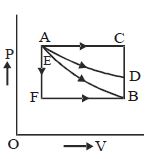
Reason : If the wires are not twisted together, the combination of the wires forms a current loop, the magnetic field generated by the loop might affect adjacent circuits or components.