Thomson coefficient of a conductor is $10\,\mu V/K$. The two ends of it are kept at ${50\,^o}C$ and ${60\,^o}C$ respectively. Amount of heat absorbed by the conductor when a charge of $10\,C$ flows through it is
Easy


Download our appand get started for free
Experience the future of education. Simply download our apps or reach out to us for more information. Let's shape the future of learning together!No signup needed.*
Similar Questions
- 1A metal wire has a resistance of $35 \,\Omega$. If its length is increased to double by drawing it, then its new resistance will be (in $\Omega$)View Solution
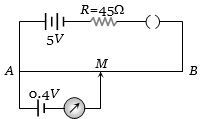
- 2In given figure, the potentiometer wire $AB$ has a resistance of $5$ $\Omega$ and length $10\, m$. The balancing length $AM$ for the $emf$ of $0.4\, V$ is ............... $m$View Solution
- 3The resistance of a wire is $R$. It is bent at the middle by $180^o$ and both the ends are twisted together to make a shorter wire. The resistance of the new wire isView Solution
- 4A potential difference of $5 \,V$ is applied across a conductor of length $10 \,cm$. If drift velocity of electrons is $2.5 \times 10^{-4} \,m / s$, then electron mobility will be ............ $m ^2 V ^{-1} s ^{-1}$View Solution
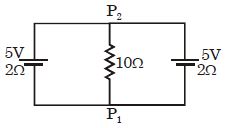
- 5Find the current in the $10\, \Omega$ resistanceView Solution
- 6If ${R_1}$ and ${R_2}$ are respectively the filament resistances of a $200$ $watt$ bulb and $100$ $watt$ bulb designed to operate on the same voltage, thenView Solution
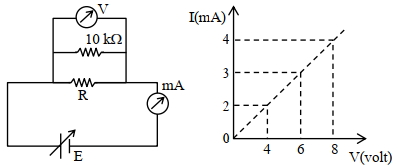
- 7To determine the resistance ($R$) of a wire, a circuit is designed below, The $V-I$ characteristic curve for this circuit is plotted for the voltmeter and the ammeter readings as shown in figure. The value of $\mathrm{R}$ is . . . . . . .$\Omega$View Solution
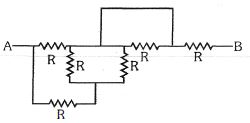
- 8What is the equivalent resistance between $A$ and $B$View Solution
- 9In the adjoining circuit diagram each resistance is of $10$ $\Omega$. The current in the arm $AD$ will beView Solution
- 10In a balanced Wheatstone’s network, the resistances in the arms $Q$ and $S$ are interchanged. As a result of thisView Solution