- Three resistors $2\ \Omega,\ 4\ \Omega\ \text{and}\ 5\ \Omega$ are combined in parallel. What is the total resistance of the combination?
- If the combination is connected to a battery of emf 20 V and negligible internal resistance, determine the current through each resistor, and the total current drawn from the battery.
Exercise
Download our app for free and get started
- Given, three resistors $2\ \Omega,\ 4\ \Omega\ \text{and}\ 5\ \Omega$ are combined in parallel.
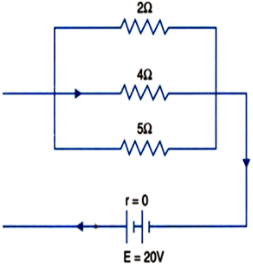
Therefore,
Total resistance of parallel combination,
$\frac{1}{\text{R}}=\frac{1}{\text{R}_1}+\frac{1}{\text{R}_2}+\frac{1}{\text{R}_3}$
$\text{or}\ \ \frac{1}{\text{R}}=\frac{1}{2}+\frac{1}{4}+\frac{1}{5}$
$=\frac{10+5+4}{20}$
$=\frac{19}{20}\ \Omega$
$\text{R}=\frac{20}{19}\ \Omega$
- The combination is connected to a battery of 20 V.
Now, using Ohm's law across each resistor we get,
$\text{I}_1=\frac{\text{V}}{\text{R}_1}=\frac{20}{2}=10\ \text{A}$
$\text{I}_2=\frac{\text{V}}{\text{R}_2}=\frac{20}{4}=5\ \text{A}$
$\text{I}_3=\frac{\text{V}}{\text{R}_3}=\frac{20}{5}=4\ \text{A}$
Hence,
Total current is given by
$\text{I}=\text{I}_1+\text{I}_2+\text{I}_3$
$=10+5+4$
$=19\ \text{A}.$

Download our appand get started for free
Experience the future of education. Simply download our apps or reach out to us for more information. Let's shape the future of learning together!No signup needed.*
Similar Questions
- 1View Solution
- Derive an expression for drift velocity of free electrons.
- How does drift velocity of electrons in a metallic conductor vary with increase in temperature? Explain.
- 2View SolutionWrite the mathematical relation for the resistivity of a material in terms of relaxation time, number density and mass and charge of charge carriers in it. Explain, using this relation, why the resistivity of a metal increases and that of a semi-conductor decreases with rise in temperature.
- 3A heating element using nichrome connected to a $230 V$ supply draws an initial current of $ 3.2 A$ which settles after a few seconds to a steady value of $2.8 A$. What is the steady temperature of the heating element if the room temperature is $27.0^\circ C?$ Temperature coefficient of resistance of nichrome averaged over the temperature range involved is $1.70\times10^{-4}{^\circ\text{C}}^{-1}.$View Solution
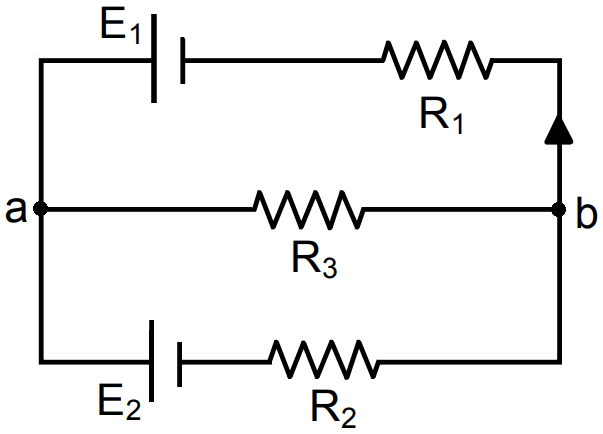
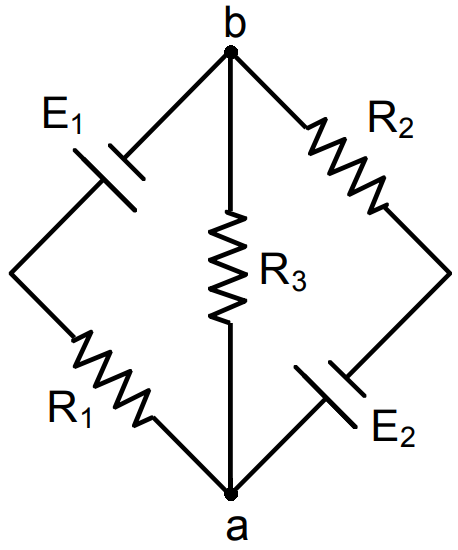
- 4Find the potential difference $V_a - V_b$ in the circuits shown in figure.View Solution
- 5View SolutionDo all the thermocouples have a neutral temperature?
- 6A uniform wire of resistance $100\Omega$ is melted and recast as a wire of length is double that of the original. What would be the resistance of the wire?View Solution
- 7View Solution
- The potential difference applied across a given resistor is altered so that the heat produced per second increases by a factor of 9. By what factor does the applied potential difference change?
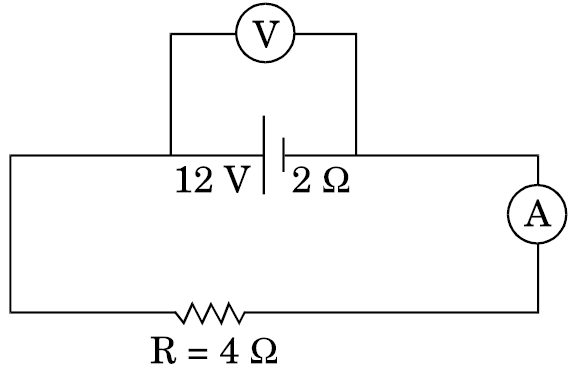
- In the figure shown, an ammeter A and a resistor of $4\Omega$ are connected to the terminals of the source. The emf of the source is 12 V having an internal resistance of $2\Omega$. Calculate the voltmeter and ammeter readings.
- 8View SolutionWrite the principle of working of a potentiometer. Describe briefly, with the help of a circuit diagram, how a potentiometer is used to determine the internal resistance of a given cell.
- 9View SolutionA potentiometer wire of length 1 m is connected to a driver cell of emf 3 V as shown in the figure. When a cell of 1.5 V emf is used in the secondary circuit, the balance point is found to be 60 cm. On replacing this cell and using a cell of unknown emf, the balance point shifts to 80 cm.
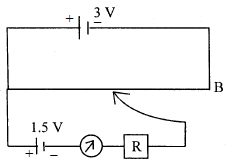
- Calculate unknown emf of the cell.
- Explain with reason, whether the circuit works, if the driver cell is replaced with a cell of emf 1 V.
- Does the high resistance R, used in the secondary circuit affect the balance point? Justify your answer.
- 10Calculate the temperature at which the resistance of a conductor becomes 20% more than its resistance at 27°C. The value of the temperature coefficient of resistance of the conductor is $2.0 \times 10\frac{-4}{\text{K}}.$View Solution