To convert a galvanometer into a ammeter, one needs to connect a
AIPMT 1992, Easy


Download our appand get started for free
Experience the future of education. Simply download our apps or reach out to us for more information. Let's shape the future of learning together!No signup needed.*
Similar Questions
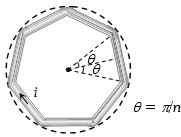
- 1In the following figure a wire bent in the form of a regular polygon of $n$ sides is inscribed in a circle of radius $a$. Net magnetic field at centre will beView Solution
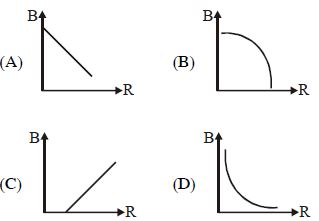
- 2Which of the following graphs correctly represents the variation of magnetic field with distance $R$ from a long straight current carrying conductor ?View Solution
- 3View SolutionIn a cyclotron, the angular frequency of a charged particle is independent of
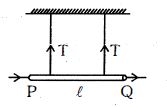
- 4A conducting bar $PQ$ of length $l$ carrying current $I$ is suspended from a rigid support as shown in figure. A uniform magnetic field $B$ perpendicular to $PQ$ and directed away from the reader (inside the plane) is applied. If the mass of the bar is $M$ the tension in each string isView Solution
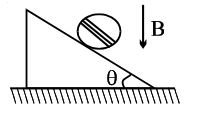
- 5In the figure shown a coil of single turn is wound on a sphere of radius $R$ and mass $m.$ The plane of the coil is parallel to the plane and lies in the equatorial plane of the sphere. Current in the coil is $i$. The value of $B$ if the sphere is in equilibrium isView Solution
- 6Proton, deuteron and alpha particle of same kinetic energy are moving in circular trajectories in a constant magnetic field. The radii of proton, deuteron and alpha particle are respectively $r_p, r_d$ and $r_{\alpha}$ Which one of the following relation is correct?View Solution
- 7A voltmeter has resistance of $2000\, ohms$ and it can measure upto $2\,V$. If we want to increase its range to $10\, V$, then the required resistance in series will be ........... $\Omega $View Solution
- 8A horizontal rod of mass $10\, gm$ and length $10\, cm$ is placed on a smooth plane inclined at an angle of $60^\circ $ with the horizontal, with the length of the rod parallel to the edge of the inclined plane. A uniform magnetic field of induction $B$ is applied vertically downwards. If the current through the rod is $1.73$ $ampere$, then the value of $B$ for which the rod remains stationary on the inclined plane is......$Tesla$View Solution
- 9A charge $q$ coulomb moves in a circle at $n$ revolutions per second and the radius of the circle is $r$ metre; then magnetic field at the centre of the circle isView Solution
- 10A galvanometer having coil resistance $10 \ \Omega$ shows a full scale deflection for a current of $3 \mathrm{~mA}$. For it to measure a current of $8 \mathrm{~A}$, the value of the shunt should be:View Solution