A long solenoid of radius $1\,mm$ has $100 $turns per $mm$. If $1\,A$ current flows in the solenoid, the magnetic field strength at the centre of the solenoid is:
NEET 2022, Easy


Download our appand get started for free
Experience the future of education. Simply download our apps or reach out to us for more information. Let's shape the future of learning together!No signup needed.*
Similar Questions
- 1When a current of $5\ mA$ is passed through a galvanometer having a coil of resistance $15\ \Omega$, it shows full scale deflection. The value of the resistance to be put in series with the galvanometer to convert it into to voltmeter of range $0 - 10\ V$ isView Solution
- 2A solenoid is $1.0$ $ metre$ long and it has $4250$ $turns$. If a current of $5.0$ $ampere$ is flowing through it, what is the magnetic field at its centre $[{\mu _0} = 4\pi \times {10^{ - 7}}\,weber/amp - m]$View Solution
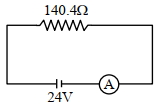
- 3In the given figure an ammeter $A$ consists of a $240 \Omega$ coil connected in parallel to a $10 \Omega$ shunt. The reading of the ammeter is . . . . . . $\mathrm{mA}$.View Solution
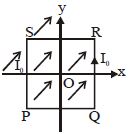
- 4A uniform, constant magnetic field $\vec B$ is directed at an angle of $45^o$ to the $x-$ axis in the $xy-$ plane, $PQRS$ is a rigid square wire frame carrying a steady current $I_0,$ with its centre at the origin $O.$ At time $t = 0,$ the frame is at rest in the position shown in the figure, with its sides parallel to the $x$ and $y$ axis. Each side of the frame is of mass $M$ and Length $L$View Solution
- 5A cylindrical conductor of radius $R$ is carrying a constant current. The plot of the magnitude of the magnetic field, $B$ with the distance $d$, from the centre of the conductor, is correctly represented by the figureView Solution
- 6View SolutionA charged particle moves through a magnetic field perpendicular to its direction. Then
- 7.......$A$ should be the current in a circular coil of radius $5\,cm$ to annul ${B_H} = 5 \times {10^{ - 5}}\,T$View Solution
- 8View SolutionTwo similar coils are kept mutually perpendicular such that their centres coincide. At the centre, find the ratio of the magnetic field due to one coil and the resultant magnetic field by both coils, if the same current is flown
- 9An electron (mass = $9.0 × $${10^{ - 31}}$ $kg$ and charge =$1.6 \times {10^{ - 19}}$ $coulomb$) is moving in a circular orbit in a magnetic field of $1.0 \times {10^{ - 4}}\,weber/{m^2}.$ Its period of revolution isView Solution
- 10A galvanometer has a resistance of $25\, ohm$ and a maximum of $0.01\, A$ current can be passed through it. In order to change it into an ammeter of range $10\, A$, the shunt resistance required isView Solution