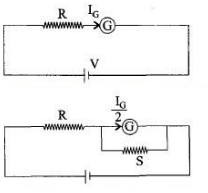
To know the resistance $G$ of a galvanometer by half deflection method, a battery of $emf\, V_E$ and resistance $R$ is used to deflect the galvanometer by angle $\theta $. If a shunt of resistance $S$ is needed to get half deflection then $G, R$ and $S$ related by the equation
JEE MAIN 2016, Diffcult


Download our appand get started for free
Experience the future of education. Simply download our apps or reach out to us for more information. Let's shape the future of learning together!No signup needed.*
Similar Questions
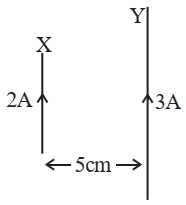
- 1A wire $X$ of length $50\; cm$ carrying a current of $2\,A$ is placed parallel to a long wire $Y$ of length $5\,m$. The wire $Y$ carries a current of $3\,A$. The distance between two wires is $5\,cm$ and currents flow in the same direction. The force acting on the wire $Y$ is.View Solution
- 2A closely packed coil having $1000$ turns has an average radius of $62.8\,cm$. If current carried by the wire of the coil is $1\,A$, the value of magnetic field produced at the centre of the coil will be (permeability of free space $=4 \pi \times 10^{-7}\,H / m$ ) nearlyView Solution
- 3A tightly wound $100$ turns coil of radius $10 \mathrm{~cm}$ carries a current of $7 \mathrm{~A}$. The magnitude of the magnetic field at the centre of the coil is (Take permeability of free space as $4 \pi \times 10^{-7} \mathrm{SI}$ units):View Solution
- 4A magnet of magnetic moment $50 \hat i\, Am^2$ is placed along the $x-$ axis in a magnetic field $\vec B = (0.5\hat i + 3.0\hat j)\,T$. The torque acting on the magnet isView Solution
- 5View SolutionOne Tesla is equal to
- 6A $90\, cm$ long solenoid has six layers of windings of $450\, turns$ each. If the diameter of solenoid is $2.2\, cm$ and current carried is $6\, A$, then the magnitude of magnetic field inside the solenoid, near its centre isView Solution
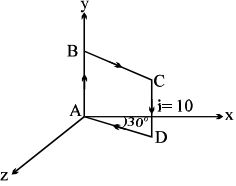
- 7Figure shows a square current carrying loop $ABCD$ of side $10\,\, cm$ and current $i = 10\,A$. The magnetic moment $\vec M$ of the loop isView Solution
- 8If $\alpha $ and $\beta - $ particles are moving with equal velocity perpendicular to the flux density $B$, then the radii of their paths will beView Solution
- 9A semi circular arc of radius $r$ and a straight wire along the diameter, both are carrying same current $i.$ Find out magnetic force per unit length on the small element $P$, which is at the centre of curvature.View Solution

- 10The magnetic force acting on charged particle of charge $2\,\mu C$ in magnetic field of $2\, T$ acting in $y-$ direction , when the particle velocity is $\left( {2\hat i + 3\hat j} \right) \times {10^6}\,m{s^{ - 1}}$ isView Solution