MCQ
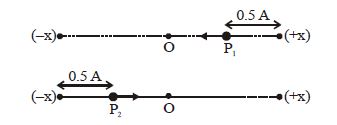
Two bodies performing $S.H.M.$ have same amplitude and frequency. Their phases at a certain instant are as shown in the figure. The phase difference between them is
  • A
    $\frac {11}{6}\pi $
  • $\pi $
  • C
    $\pi /3$
  • D
    $\frac {3}{5}\pi $

Answer

Correct option: B.
$\pi $
b
First particle is comming towards mean position

$\therefore \phi_{1}=\pi-\frac{\pi}{6}$

second particle is comming towards mean position but in negative side

$\therefore \phi_{2}=2 \pi-\frac{\pi}{6}$

$\therefore \phi_{2}-\phi_{1}=\left(2 \pi-\frac{\pi}{6}\right)-\left(\pi-\frac{\pi}{6}\right)=\pi$

Need a full question paper?

Generate a complete, print-ready paper with questions like this in minutes — across 16+ boards, with answer keys.
Start Generating Free

Similar questions

A far off planet is estimated to be at a distance $D$ from the earth. If its diametrically opposite extremes subtend an angle $\theta$ at an observatory situated on the earth, the approximate diameter of the planet is ............. 
Vapour is injected at a uniform rate in a closed veseel which was initially evacuated. The pressure in the vessel:
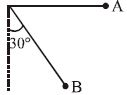
A simple pendulum is released from $A$ as shown in figure. If $m$ and $l$ represent the mass of the bob and the length of the pendulum respectively, the gain in kinetic energy at $B$ is
A circular disc reaches from top to bottom of an inclined plane of length $l$. When it slips down the plane, if takes $\mathrm{t} \mathrm{s}$. When it rolls down the plane then it takes $\left(\frac{\alpha}{2}\right)^{1 / 2} \mathrm{t} s$, where $\alpha$ is. . . . . . . .  
There is relationship between the mean free path of the molecules of a gas and its density.
The frequency of echo will be $.......Hz$ if the train blowing a whistle of frequency $320\,Hz$ is moving with a velocity of $36\,km / h$ towards a hill from which an echo is heard by the train driver. Velocity of sound in air is $330\,m / s$.
Name the particle that initiates the electromagnetic force between two electrons.
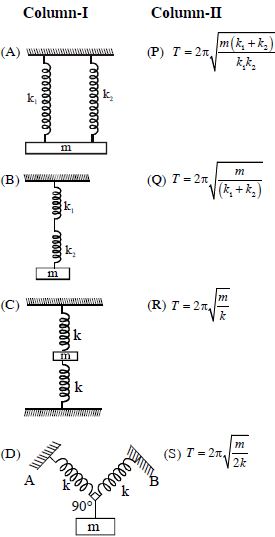
In the following questions, match column $-I$ with column $-II$ and choose the correct options
The kinetic energy of a particle continuously increases with time:
An oscillator of mass $M$  is at rest in its equilibrium position in a potential $V\, = \,\frac{1}{2}\,k{(x - X)^2}.$ A particle of mass $m$  comes from right with speed $u$  and collides completely inelastically with $M$ and sticks to it . This process repeats every time the oscillator crosses its equilibrium position .The amplitude of oscillations after $13$  collisions is: $(M = 10,\, m = 5,\, u = 1,\, k = 1 ).$