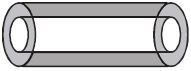
Two bulbs consume same power when operated at $200\, V$ and $300\, V$ respectively. When these bulbs are connected in series across a $D.C$. source of $500\, V$, then
Medium


Download our appand get started for free
Experience the future of education. Simply download our apps or reach out to us for more information. Let's shape the future of learning together!No signup needed.*
Similar Questions
- 1View SolutionThe following four wires are made of the same material and are at the same temperature. Which one of them has highest electrical resistance
- 2View SolutionThe material of wire of potentiometer is
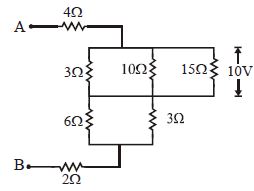
- 3Calculate the potential difference between, points $A$ and $B$ and current flowing in $10\,\Omega $ resistor in the part of network belowView Solution
- 4Which of the following wiring diagrams could be used to experimentally determine $R$ using ohm's law? Assume an ideal voltmeter and an ideal ammeter.View Solution
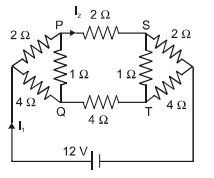
- 5For the resistance network shown in the figure, choose the correct option$(s)$. $Image$View Solution
$(A)$ The current through $P Q$ is zero.
$(B)$ $I_1=3 A$.
$(C)$ The potential at $S$ is less than that at $Q$.
$(D)$ $I _2=2 A$.
- 6An electric iron draws $5\, amp$, a $TV$ set draws $3\, amp$ and refrigerator draws $2\, amp$ from a $220\, volt$ main line. The three appliances are connected in parallel. If all the three are operating at the same time, the fuse used may be of ............. $amp$View Solution
- 7If a $30\, V$, $90\, W$ bulb is to be worked on a $120\, V$ line, a resistance of how many ohms should be connected in series with the bulb ............... $ohm$View Solution
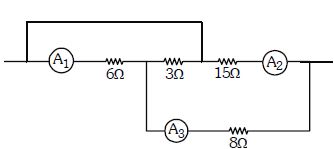
- 8A part of circuit is shown in figure. All the ammeters are ideal. If reading of ammeter $A_1$ is $1.0\ A$ , thenView Solution
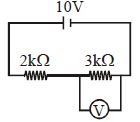
- 9In the circuit shown in figure, the resistance of voltmeter is $6\, k\Omega $. The voltmeter reading will be ................. $\mathrm{V}$View Solution
- 10In given hollow cylindrical conductor current density is $J = \frac{J_0}{r^2}$ where $J_0$ is constant and $r$ is the distance from axis of cylinder. If radius of inner surface is $'a'$ and radius of outer surface is $2a$ then find current passed through the conductor.View Solution