Two capillary tubes of the same length but different radii $r_1 $ and $r_2$ are fitted in parallel to the bottom of a vessel. The pressure head is $ P. $ What should be the radius of a single tube that can replace the two tubes so that the rate of flow is same as before
Diffcult


Download our appand get started for free
Experience the future of education. Simply download our apps or reach out to us for more information. Let's shape the future of learning together!No signup needed.*
Similar Questions
- 1An inverted tube barometer is kept on a lift with a moving downward with a deceleration $\alpha $ . The density of mercury is $\rho$ and acceleration due to gravity is $g$ . If the atmospheric pressure be $P_0$ thenView Solution
- 2An ornament weighs $10\, g$ in air and $6\, g$ in water. Density of material of ornament is $20\,\frac{g}{{cc}}$. The volume of cavity in ornament is ........ $cc$View Solution
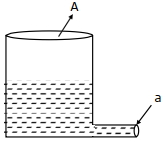
- 3A light cylindrical vessel is kept on a horizontal surface. Area of base is A. A hole of crosssectional area $'a'$ is made just at its bottom side. The minimum coefficient of friction necessary to prevent sliding the vessel due to the impact force of the emerging liquid is $(a\,<\,<\,A)$View Solution
- 4Two solids $A$ and $ B$ float in water. It is observed that $A$ floats with $\frac{1}{2}$ of its body immersed in water and $ B$ floats with $\frac{1}{4}$ of its volume above the water level. The ratio of the density of $ A$ to that of $B$ isView Solution
- 5View SolutionAn ice block contains a glass ball when the ice melts within the water containing vessel, the level of water
- 6$Assertion :$ For Reynold’s number $Re > 2000$, the flow of fluid is turbulent.View Solution
$Reason :$ Inertial forces are dominant compared to the viscous forces at such high Reynold’s numbers. - 7A steel wire is suspended vertically from a rigid support. When loaded with a weight in air, it extends by $l_a$ and when the weight is immersed completely in water, the extension is reduced to $l_w$. Then the relative density of material of the weight isView Solution
- 8When a large bubble rises from the bottom of a lake to the surface. Its radius doubles. If atmospheric pressure is equal to that of column of water height $H$, then the depth of lake isView Solution
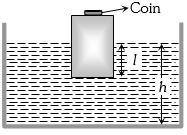
- 9A wooden block, with a coin placed on its top, floats in water as shown in fig. the distance $l $ and $h$ are shown there. After some time the coin falls into the water. ThenView Solution
- 10A cubical block of side $0.5\,m$ floats on water with $30\%$ of its volume under water. ....... $kg$ is the maximum weight that can be put on the block without fully submerging it under water ? [Take density of water $= 10^3\,kg/m^3$ ]View Solution