Two electric bulbs whose resistances are in the ratio of $1 : 2$ are connected in series. The powers dissipated in them have the ratio
AIPMT 1997, Easy


Download our appand get started for free
Experience the future of education. Simply download our apps or reach out to us for more information. Let's shape the future of learning together!No signup needed.*
Similar Questions
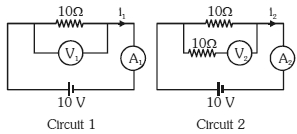
- 1View SolutionIn the circuits shown below, the readings of the voltmeters and the ammeters will be
- 2View SolutionWhich of the following is not a correct statement
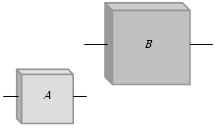
- 3$A$ and $B$ are two square plates of same metal and same thickness but length of $B$ is twice that of $A$. Ratio of resistances of $A$ and $B$ isView Solution
- 4A student obtained following observations in an experiment of meter bridge to find the unknown resistance of the circuit The most accurate value of unknown resistance is ............ $\Omega$View Solution
S.No. $R$ $l$ $100-l$ $S = \left( {\frac{{100 - l}}{l}} \right)R$ $1$ $20\,\Omega $ $43$ $57$ $26.51\,\Omega $ $2$ $30\,\Omega $ $51$ $49$ $28.82\,\Omega $ $3$ $40\,\Omega $ $59$ $41$ $27.80\,\Omega $ $4$ $60\,\Omega $ $70$ $30$ $25.71\,\Omega $ - 5In a metre-bridge when a resistance in the left gap is $2\ \Omega$ and unknown resistance in the right gap, the balance length is found to be $40\ \mathrm{~cm}$. On shunting the unknown resistance with $2\ \Omega$, the balance length changes by :View Solution
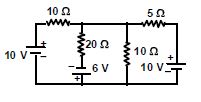
- 6The value of current through the $20\,\Omega $ resistor is ............ $amp$View Solution
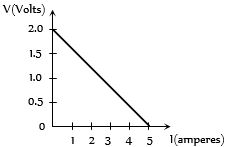
- 7For a cell, the graph between the potential difference $(V) $ across the terminals of the cell and the current $(I)$ drawn from the cell is shown in the figure. The $e.m.f.$ and the internal resistance of the cell areView Solution
- 8View SolutionExpress which of the following setups can be used to verify Ohm’s law
- 9View SolutionAssertion : Kirchoff 's junction rule follows from conservation of charge.
Reason : Kirchoff 's loop rule follows from conservation of momentum.
- 10What equal length of an iron wire and a copper-nickel alloy wire, each of $2 \; {mm}$ diameter connected parallel to give an equivalent resistance of $3 \Omega ?$View Solution
(Given resistivities of iron and copper-nickel alloy wire are $12 \;\mu \Omega {cm}$ and $51\; \mu \Omega {cm}$ respectively) (in ${m}$)