Two gases are at absolute temperatures $300 K $ and $350 K$ respectively. Ratio of average kinetic energy of their molecules is
Medium


Download our appand get started for free
Experience the future of education. Simply download our apps or reach out to us for more information. Let's shape the future of learning together!No signup needed.*
Similar Questions
- 1View SolutionIn Boyle's law what remains constant
- 2When an air bubble of radius $‘r’$ rises from the bottom to the surface of a lake, its radius becomes $5r/4$ (the pressure of the atmosphere is equal to the $10 \,m$ height of water column). If the temperature is constant and the surface tension is neglected, the depth of the lake is .... $m$View Solution
- 3View SolutionThe product of the pressure and volume of an ideal gas is
- 4An ideal gas of Molar mass $M$ is contained in a vertical tube of height $H$, closed at both ends. The tube is accelerating vertically upwards with acceleration $g$ Then, the ratio of pressure at the bottom and the mid point of the tube will beView Solution
- 5View SolutionThe degrees of freedom of a triatomic gas is
- 6$Assertion :$ Mean free path of a gas molecules varies inversely as density of the gas.View Solution
$Reason :$ Mean free path varies inversely as pressure of the gas. - 7A mixture of hydrogen and oxygen has volume $500\, {cm}^{3}$, temperature $300\, {K}$, pressure $400\, {kPa}$ and mass $0.76\, {g}$. The ratio of masses of oxygen to hydrogen will be :-View Solution
- 8Which one of the following schematic graphs best represents the variation of $p V$ (in Joules) versus $T$ (in Kelvin) of one mole of an ideal gas? (The dotted line represents $p V=T$ )View Solution
- 9A gas mixture consists of $2$ moles of oxygen and 4 moles of neon at temperature $T$. Neglecting all vibrational modes, the total internal energy of the system will be $...........\,RT$View Solution
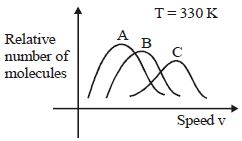
- 10View SolutionMaxwell distribution function is shown in figure for different gases, which of the following is correct matching?