Question
Two long straight parallel conductors carry steady current $I_1$ and $I_2$ separated by a distance $d.$ If the currents are flowing in the same direction, show how the magnetic field set up in one produces an attractive force on the other. Obtain the expression for this force. Hence define one ampere.
Answer


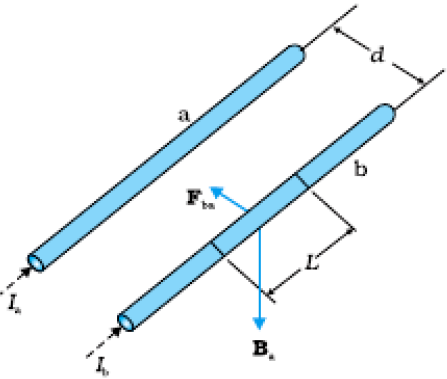
As shown in Figure, the direction of force on conductor $b$ is attractive.
Alternate Answer
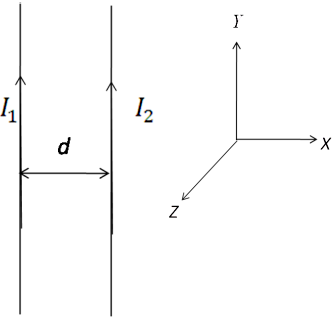
$\overrightarrow{\text{B}}$at a point on wire $2,$ is along $- \hat{\text{k}}$
$\therefore\overrightarrow{\text{F}} , $ 
on wire $2,$ due to the  $\overrightarrow{\text{B}}$ is along $-$ $\hat{\text{i}}$ 
i.e.towards wire$1.$
Hence the force is attractive.

Magnetic field, due to current in conductor $a,$
$\text{B}_{1} = \frac{\mu_\circ\text{I}_{1}}{2\pi\text{d}}$
The magnitude of force on a length $L$ of conductor $b,$
$\text{F}_{2} = \text{I}_{2}\text{LB}_{1}$
$\text{F}_{2} =\frac{\mu_\circ\text{I}_{1}\text{I}_{2}\text{L}}{2\pi\text{d}}$
One ampere is that steady current which,
when maintained in each of the two very long, straight, parallel conductors,
placed one meter apart in vacuum,
would produce on each of these conductors a force equal to $2 \times10^{-7}$ newton per meter of their length.

Need a full question paper?

Generate a complete, print-ready paper with questions like this in minutes — across 16+ boards, with answer keys.

Start Generating Free

Similar questions

Careful measurement of the electric field at the surface of a black box indicates that the net outward flux passing through the surface of the box is $8.0 \times 10^3 Nm ^2 / C$.
(a) What is the net charge inside the box?
(b) If the net outward flux through the surface of the box were zero, could you conclude that there were no charges inside the box? Why or why not?
A small spherical ball is released from a point at a height h on a rough track shown in figure. Assuming that it does not slip anywhere, find its linear speed when it rolls on the horizontal part of the track.
In an experiment on photoelectric effect, the slope of the cut-off voltages versus frequency of incident light is found to be $4.12 \times 10^{-15}$ V s. Calculate the value of Planck's constant.
Write the principle of working of a potentiometer. Describe briefly, with the help of a circuit diagram, how a potentiometer is used to determine the internal resistance of a given cell.
A narrow beam of light passes through a slab obliquely and is then received by an eye. The index of refraction of the material in the slab fluctuates slowly with time. How will it appear to the eye? The twinkling of stars has a similar explanation.
A charge Q is distributed uniformly over a metallic sphere of radius R. Obtain the expressions for the electric field (E) and electric potential (V) at a point 0 < x < R.
Show on a plot the variation of E and V with x for 0 < x < 2R.
A wheel rotating at a speed of $600\ rpm ($revolutions per minute$)$ about its axis is brought to rest by applying a constant torque for $10$ seconds. Find the angular deceleration and the angular velocity $5$ seconds after the application of the torque.
  1. How are electromagnetic waves produced? Explain.
  2. A plane electromagnetic wave is travelling through a medium along the +ve z-direction. Depict the electromagnetic wave showing the directions of the oscillating electric and magnetic fields.
Double $-$ convex lenses are to be manufactured from a glass of refractive index $1.55,$ with both faces of the same radius of curvature. What is the radius of curvature required if the focal length is to be $20\ cm$?
  1. Three resistors $2\ \Omega,\ 4\ \Omega\ \text{and}\ 5\ \Omega$ are combined in parallel. What is the total resistance of the combination?
  2. If the combination is connected to a battery of emf 20 V and negligible internal resistance, determine the current through each resistor, and the total current drawn from the battery.