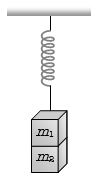
Two masses $m_1$ and $m_2$ are suspended together by a massless spring of constant $K$. When the masses are in equilibrium, $m_1$ is removed without disturbing the system. The amplitude of oscillations is
Medium
Download our app for free and get started
(a)With mass ${m_2}$ alone, the extension of the spring l is given as ${m_2}g = kl$ ...(i)
With mass $({m_1} + {m_2})$, the extension $l'$ is given by
$({m_1} + {m_2})g = k(l + \Delta l)$ ....(ii)
The increase in extension is $\Delta l$ which is the amplitude of vibration. Subtracting (i) from (ii), we get
${m_1}g = k\Delta l$ or $\Delta l = \frac{{{m_1}g}}{k}$
With mass $({m_1} + {m_2})$, the extension $l'$ is given by
$({m_1} + {m_2})g = k(l + \Delta l)$ ....(ii)
The increase in extension is $\Delta l$ which is the amplitude of vibration. Subtracting (i) from (ii), we get
${m_1}g = k\Delta l$ or $\Delta l = \frac{{{m_1}g}}{k}$

Download our appand get started for free
Experience the future of education. Simply download our apps or reach out to us for more information. Let's shape the future of learning together!No signup needed.*
Similar Questions
- 1A particle which is simultaneously subjected to two perpendicular simple harmonic motions represented by; $x = {a_1}\,\cos \,\omega t$ and $y = {a_2}\,\cos \,2\,\omega t$ traces a curve given byView Solution
- 2A pendulum suspended from the ceiling of a train oscillates with a time period $2\,second$, when the train is accelerating at $10\,ms^{-2}$. What will be its time period when the train retards at $10\,ms^{-2}$ ? ..... $\sec$View Solution
- 3If the maximum velocity and maximum acceleration of a particle executing $SHM$ are equal in magnitude, the time period will be .... $\sec$View Solution
- 4Two springs have spring constants ${K_A}$ and ${K_B}$ and ${K_A} > {K_B}$. The work required to stretch them by same extension will beView Solution
- 5The displacement y of a particle executing periodic motion is given by $y = 4{\cos ^2}(t/2)\sin (1000t)$. This expression may be considered to be a result of the superposition of ........... independent harmonic motionsView Solution
- 6As a body performs $S.H.M.$, its potential energy $U.$ varies with time as indicated inView Solution
- 7The period of a simple pendulum measured inside a stationary lift is found to be $T$. If the lift starts accelerating upwards with acceleration of $g/3,$ then the time period of the pendulum isView Solution
- 8A stationary tuning fork is in resonance with an air column in a pipe. If the tuning fork is moved with a speed of $2 ms ^{-1}$ in front of the open end of the pipe and parallel to it, the length of the pipe should be changed for the resonance to occur with the moving tuning fork. If the speed of sound in air is $320 ms ^{-1}$, the smallest value of the percentage change required in the length of the pipe is. . . . . .View Solution
- 9A sphere of radius $r$ is kept on a concave mirror of radius of curvature $R$. The arrangement is kept on a horizontal table (the surface of concave mirror is frictionless and sliding not rolling). If the sphere is displaced from its equilibrium position and left, then it executes $S.H.M.$ The period of oscillation will beView Solution
- 10The kinetic energy and potential energy of a particle executing simple harmonic motion will be equal, when displacement (amplitude = $a$) isView Solution