Question
What happens when a forward bias is applied to a $p-n$ junction?

Answer

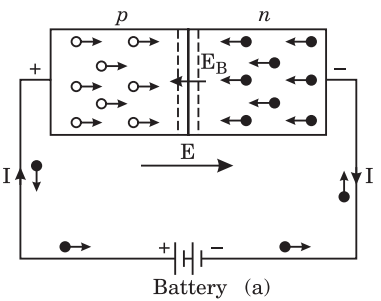
Forward Biasing: When the positive terminal of an external battery is connected to the $p$-region and negative terminal of the battery to the $n$-region of a $p-n$ junction then the junction is said to be forward-biased and this process is known as forward biasing of the junction. Hence in this biasing an external field E is set up on the junction which is directed from $p$-region to $n$-region of the junction. It is obvious that this field is in the direction opposite to the direction barrier field $\vec{E}_{B}$.
Image
The electric field E is much stronger than the opposing field $E_{B}$. Therefore, the force on the positive hole will act in the direction of field E and the force on the negatively charged electron will act in the direction opposite to that of $\vec{E}$. Therefore, positive holes of $p$-region and electrons of $n$-region both move towards the $p-n$ junction. These holes and electrons combine with each other near the junction and their existence is gone. Now for each electron-hole combination a covalent band breaks up in $p$-region near the positive terminal of the battery. Now out of the newly produced hole and electron, the hole moves towards the junction while the electron enters the positive terminal of the battery through the connecting wire used. At the same instant an electron is detached from the negative terminal of the battery and enters the $n$-region to compensate the electron loss in the combination with hole at the junction. In this way the flow of majority charge carriers i.e., holes in $p$-region and electron in n-region constitutes an electric current across the $p-n$ junction. The electric current flowing through the junction in forward biasing is called forward current. The electric current in the external circuit is due to the flow of electrons as shown is Fig. (a).
In addition to the large forward current, a small current due to the motion of minority carriers i.e., electrons in $p$-region and holes in n-region flows in the direction opposite to the forward current. This current is called reversed current, but it is almost negligible.
In forward biasing of a $p-n$ junction applied external electric field E dominates the small barrier field $E_{B}$, hence majority charge carriers i.e., holes in $p$-region and electron in n-region are pulled towards the junction. Therefore, in this biasing, the width of the depletion layer decreases due to which $p-n$ junction offers a low resistance for the forward biased current.
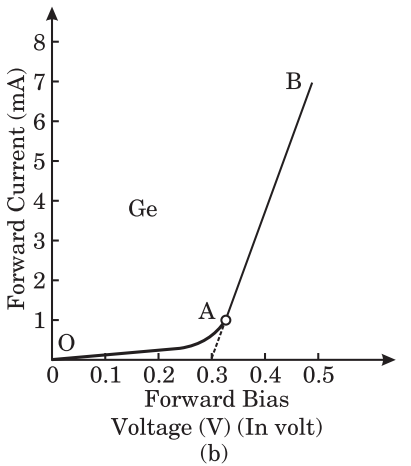
Voltage-Current Characteristic Curve : For forward biasing of a $p-n$ junction the graph drawn between applied voltage known as forward bias voltage V and the corresponding forward biased current is shown in Fig. (b). This is voltage-current characteristic curve of $p-n$ junction in forward biasing. It has been drawn for Germanium $p-n$ junction.
Image
It is obvious from the curve that in the beginning when the applied voltage is low (of the order of barrier voltage ≈ 0.3 V) the current through the junction is almost zero because both these voltages oppose each other. As the applied voltages is increased the current increases very slowly and nonlinearly until the applied voltage becomes greater than barrier voltage or say potential barrier. This behaviour of the junction is shown by the graph portion OA. With further increase in applied voltage forward biased current increases very rapidly and linearly. In this position the junction behaves as a conductor. This behaviour of junction is shown by straight line part AB of characteristic curve. When this straight line is drawn back, it intersects the voltage-axis at barrier voltage.

Need a full question paper?

Generate a complete, print-ready paper with questions like this in minutes — across 16+ boards, with answer keys.
Start Generating Free

Similar questions

A room has a window fitted with a single $1.0m \times 2.0m$ glass of thickness $2 \ mm.$
  1. Calculate the rate of heat flow through the closed window when the temperature inside the room is $32^\circ C$ and that outside is $40^\circ C.$
  2. The glass is now replaced by two glasspanes, each having a thickness of $1 \ mm$ and separated by a distance of $1 \ mm.$ Calculate the rate of heat flow under the same conditions of temperature. Thermal conductivity of window glass $= 1.0Js^{-1}m^{-1^\circ }C^{-1}$ and that of air $= 0.025Js^{-1}m^{-1^\circ }C^{-1}.$
Describe the main difference between Fraunhofer and Fresnel's diffraction. 
A particle on a stretched string supporting a travelling wave, takes 5.0ms to move from its mean position to the extreme position. The distance between two consecutive particles, which are at their mean positions, is 2.0cm. Find the frequency, the wavelength and the wave speed.
Explain direct current direct emf and draw their graphs. Define alternating current and explain in detail.
A cylindrical vessel of diameter $12\ cm$ contains $800\pi\text{cm}^3$ of water. A cylindrical glass piece of diameter $8.0 \ cm$ and height $8.0\ cm$ is placed in the vessel. If the bottom of the vessel under the glass piece is seen by the paraxial rays, locate its image. The index of refraction of glass is $1.50$ and that of water is $1.33.$​​​​​​​
In a Geiger-Marsden experiment, what is the distance of closest approach to the nucleus of a $7.7 MeV \alpha$-particle before it comes momentarily to rest and reverses its direction?
Find out magnetic force on parallel current carrying conductors and also state their special conditions.
A long, straight wire carrying a current of $30A$ is placed in an external, uniform magnetic field of $4.0 \times 10^{-4}T$ parallel to the current. Find the magnitude of the resultant magnetic field at a point $2.0\ cm$ away from the wire.
i. With the help of a diagram, explain the principle and working of a device which produces current that reverses its direction after regular intervals of time.
ii. If a charged capacitor C is short-circuited through an inductor L, the charge and current in the circuit oscillate simple harmonically. a. In what form the capacitor and the inductor store energy? b. Write two reasons due to which the oscillations become damped.
Assume that a tunnel is dug along a chord of the earth, at a perpendicular distance $\frac{\text{R}}{2}$ from the earth's centre where R is the radius of the earth. The wall of the tunnel is frictionless.
  1. Find the gravitational force exerted by the earth on a particle of mass m placed in the tunnel at a distance x from the centre of the tunnel.
  2. Find the component of this force along the tunnel and perpendicular to the tunnel.
  3. Find the normal force exerted by the wall on the particle.
  4. Find the resultant force on the particle.
  5. Show that the motion of the particle in the tunnel is simple harmonic and find the time period.