Two rods $A$ and $B$ of different materials are welded together as shown in figure.Their thermal conductivities are $K_1$ and $K_2$ The thermal conductivity of the composite rod will be
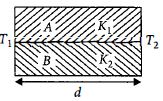
NEET 2017, Medium


Download our appand get started for free
Experience the future of education. Simply download our apps or reach out to us for more information. Let's shape the future of learning together!No signup needed.*
Similar Questions
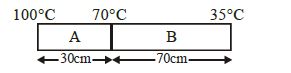
- 1Two different rods $A$ and $B$ are kept as shown in figure. The ratio of thermal conductivities of $A$ and $B$ isView Solution
- 2A cylindrical metallic rod in thermal contact with two reservoirs of heat at its two ends conducts an amount of heat $Q$ in time $t$. The metallic rod is melted and the material is formed into a rod of half the radius of the original rod. What is the amount of heat conducted by the new rod, when placed in thermal contact with the two reservoirs in time $t$ ?View Solution
- 3The thickness of a metallic plate is $0.4 cm$ . The temperature between its two surfaces is ${20^o}C$. The quantity of heat flowing per second is $50$ calories from $5c{m^2}$ area. In $CGS$ system, the coefficient of thermal conductivity will beView Solution
- 4View SolutionThe layers of atmosphere are heated through
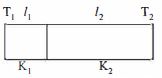
- 5One end of a thermally insulated rod is kept at a temperature $T_1$ and the other at $T_2$ . The rod is composed of two sections of length $l_1$ and $l_2$ and thermal conductivities $K_1$ and $K_2$ respectively. The temperature at the interface of the two section isView Solution
- 6A rod of length $L$ and uniform cross-sectional area has varying thermal conductivity which changes linearly from $2K$ at endAto $K$ at the other end $B$. The endsA and $B$ of the rod are maintained at constant temperature $100^o C$ and $0^o C$, respectively. At steady state, the graph of temperature : $T = T(x)$ where $x =$ distance from end $A$ will beView Solution
- 7The total radiative power emitted by spherical black body with radius $R$ and temperature $T$ is $P$. If the radius is doubled and the temperature is halved, then the radiative power will beView Solution
- 8A body cools in $7$ minutes from ${60^o}C$ to ${40^o}C$ What time (in minutes) does it take to cool from ${40^o}C$ to ${28^o}C$ if the surrounding temperature is ${10^o}C$? Assume Newton’s Law of cooling holdsView Solution
- 9A black body at a temperature of ${227^o}C$ radiates heat energy at the rate of $5 cal/cm^2-sec$. At a temperature of ${727^o}C$, the rate of heat radiated per unit area in $cal/cm^2$ will beView Solution
- 10It takes $10$ minutes to cool a liquid from $61^oC$ to $59^oC$. If room temperature is $30^oC$ then time taken in cooling from $51^oC$ to $49^oC$ is ....... $\min$View Solution