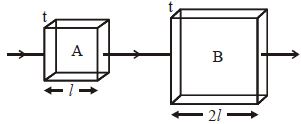
Two square metal plates $A$ and $B$ are of the same thickness and material. The side of $B$ is twice that of $A$. These are connected as shown in series. If the resistances of $A$ and $B$ are denoted by $R_A$ and $R_B,$ then $(R_A/R_B)$ is
Medium


Download our appand get started for free
Experience the future of education. Simply download our apps or reach out to us for more information. Let's shape the future of learning together!No signup needed.*
Similar Questions
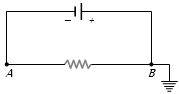
- 1A battery is connected to a uniform resistance wire $AB$ and $B$ is earthed. Which one of the graphs below shows how the current density $J$ varies along $AB$View Solution
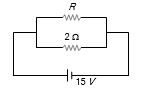
- 2If in the circuit, power dissipation is $150\, W$, then $R$ is ............... $\Omega$View Solution
- 3A uniform heating wire of resistance $36\, \Omega$ is connected across a potential difference of $240\, {V}$ The wire is then cut into half and potential difference of $240\, {V}$ is applied across each half separately. The ratio of power dissipation in first case to the total power dissipation in the second case would be $1: {x}$, where ${x}$ is........... .View Solution
- 4A resistance of $2 \Omega$ is comnected across one gap of a metre-bridge (the length of the wire is $100 \mathrm{~cm}$ ) and an unknown resistance, greater than $2 \Omega$, is connected across the other gap. When these resistance are interchanged, the balance point shifts by $20 \mathrm{~cm}$. Neglecting any corrections, the unknown resistance isView Solution
- 5The current in the primary circuit of a potentiometer is $0.2\, A$. The specific resistance and cross section of the potentiometer wire are $4\times10^{-7}\,ohm$ $metre$ and $8\times10^{-7}\, m^2$ respectively. The potential gradient will be equal to .............. $V/m$View Solution
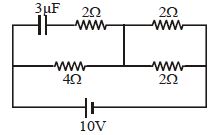
- 6Find charge stored on the capacitor in steady state condition .............. $\mu C$View Solution
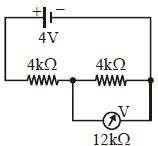
- 7The percentage error in the reading of the voltmeter in the figure shown here is nearly ............ $\%$View Solution
- 8Some electric bulbs are connected in series across a $220\, V$ supply in a room. If one bulb is fused then remaining bulbs are connected again in series across the same supply. The illumination in the room willView Solution
- 9If $n,\,e,\,\tau $ and $m$ respectively represent the density, charge relaxation time and mass of the electron, then the resistance of a wire of length $l$ and area of cross-section $A$ will beView Solution
- 10The current in a conductor varies with time t as $I = 2t + 3{t^2}$ where $I$ is in ampere and $t$ in seconds. Electric charge flowing through a section of the conductor during $t = 2\,\sec$ to $t = 3\,\sec$ is ............. $C$View Solution