MCQ
Two vibrating tuning forks produce progressive waves given by $y_1= 4 \sin (500 \, \pi t)$  and $y_2= 2 \sin (506 \, \pi t)$. These tuning forks are held near the ear of a person.  The person will hear
  • A
    $3\, beats/s$ with intensity ratio between maxima and minima equal to $4$
  • $3 \,beats/s$ with intensity ratio between maxima and minima equal to $9.$
  • C
    $6\, beats/s$ with intensity ratio between maxima and minima equal to $4.$
  • D
    $6\, beats/s$ with intensity ratio between maxima and minima equal to $9.$
Answer

Correct option: B.
$3 \,beats/s$ with intensity ratio between maxima and minima equal to $9.$
b
$Y_{1}=4 \sin (500 \pi t), Y_{2}=2 \sin (506 \pi t)$

$\mathrm{n}_{1}=250 \mathrm{\,Hz}, \mathrm{n}_{2}=253 \mathrm{\,Hz}$

No. of Beats $=n_{1}-n_{2}=3$

$\mathrm{I}_{1} \propto 16, \mathrm{I}_{2} \propto 4$

$\frac{I_{\max }}{I_{\min }}=\frac{(\sqrt{I_{1}}+\sqrt{I_{2}})^{2}}{(\sqrt{I_{1}}-\sqrt{I_{2}})^{2}}=\left(\frac{4+2}{4-2}\right)^{2}=\left(\frac{6}{2}\right)^{2}=9$

Need a full question paper?

Generate a complete, print-ready paper with questions like this in minutes — across 16+ boards, with answer keys.

Start Generating Free

Similar questions

Regarding speed of sound in gas match the following

$(A)$ Temperature of gas is made $4$ times and pressure $2$ times

$(P)$ Speed becomes $2\sqrt 2$ times

$(B)$ Only pressure is made $4$ times without change in temperature

$(Q)$ Speed become $2$ times

$(C)$ Only temperature is changed to $4$ times

$(R)$ Speed remains unchanged

$(D)$ Molecular mass of the gas is made $4$ times

$(S)$ Speed becomes half

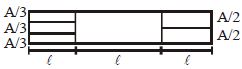
For the shown figure, calculate the equivalent thermal resistance if the bricks made of the same material of conductivity $K$
$Assertion$ : If collision occurs between two elastic bodies their kinetic energy decreases during the time of collision.

$Reason$ : During collision intermolecular space decreases and hence elastic potential energy increases.

Angular displacement $(\theta )$ of a flywheel varies with time as $\theta  = at + b{t^2} + c{t^3}$ then angular acceleration is given by  
The frequency of fundamental tone in an open organ pipe of length $0.48 m$ is $320 Hz.$ Speed of sound is $320 m/sec.$ Frequency of fundamental tone in closed organ pipe will be  ... $Hz$
The densities of two solid spheres $A$ and $B$ of the same radii $R$ vary with radial distance $r$ as $\rho_A(r)=$ $k \left(\frac{ r }{ R }\right)$ and $\rho_B( r )= k \left(\frac{ r }{ R }\right)^5$, respectively, where $k$ is a constant. The moments of inertia of the individual spheres about axes passing through their centres are $I_A$ and $I_B$, respectively. If $\frac{I_B}{I_A}=\frac{n}{10}$, the value of $n$ is
Two satellites $A$ and $B$ having masses in the ratio $4: 3$ are revolving in circular orbits of radii $3\,r$ and $4\,r$ respectively around the earth. The ratio of total mechanical energy of $A$ to $B$ is.
For Boyle's law to hold the gas should be
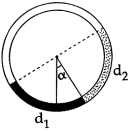
There is a circular tube in a vertical plane. Two liquids which do not mix and of densities $d_1$ and $d_2$ are filled in the tube. Each liquid subtends $90^o$ angle at centre. Radius joining their interface makes an angle $\alpha$ with vertical. Ratio $\frac{{{d_1}}}{{{d_2}}}$ is
Two particles are executing simple harmonic motion of the same amplitude $A$ and frequency $\omega $ along the $x-$ axis. Their mean position is separated by distance $X_0 (X_0> A)$. If the maximum separation between them is $(X_0 +A)$, the phase difference between their motion is