Two waves of wavelengths $99\, cm$ and $100\, cm$ both travelling with velocity $396\, m/s$ are made to interfere. The number of beats produced by them per second is
Medium
Download our app for free and get started
Velocity of wave $\mathrm{v}=\mathrm{n} \lambda$
where $\mathrm{n}=$ frequency of wave $\Rightarrow \mathrm{n}=\frac{\mathrm{v}}{\lambda}$
$\mathrm{n}_{2}=\frac{\mathrm{v}_{2}}{\lambda_{2}}=\frac{396}{100 \times 10^{-2}}=396 \mathrm{Hz}$
no. of beats $=n_{1}-n_{2}=4$

Download our appand get started for free
Experience the future of education. Simply download our apps or reach out to us for more information. Let's shape the future of learning together!No signup needed.*
Similar Questions
- 1The amplitude of wave disturbance propagating in the positive $x$-direction is given by $y=\frac{1}{(1+x)^{2}}$ at time $t=0$ and $y=\frac{1}{1+(x-2)^{2}}$ at $t=1$ s, where $x$ and $y$ are in metres. The shape of wave does not change during the propagation. The velocity of the wave will be $...\,{m} / {s}.$View Solution
- 2A siren emitting a sound of frequency $800\,\, Hz$ moves away from an observer towards a cliff at a speed of $15 \,\,m s^{-1}$. Then, the frequency of sound that the observer hears in the echo reflected from the cliff is .... $Hz$View Solution
(Take velocity of sound in air $= 330\,\, m s^{-1}$) - 3A tuning fork $A$ of unknown frequency produces $5\, beats/s$ with a fork of known frequency $340\, Hz$. When fork $A$ is filed, the beat frequency decreases to $2\, beats/s.$ What is the frequency of fork $A$ ? (in $Hz$)View Solution
- 4View SolutionThe waves in which the particles of the medium vibrate in a direction perpendicular to the direction of wave motion is known as
- 5A sonometer wire, with a suspended mass of $M = 1\, kg$, is in resonance with a given tuning fork. The apparatus is taken to the moon where the acceleration due to gravity is $(1/6)$ that on earth. To obtain resonance on the moon, the value of $M$ should be ......... $kg$View Solution
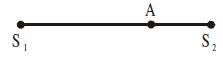
- 6If $y_1 = 5 (mm)\ \sin\pi t$ is equation of oscillation of source $S_1$ and $y_2$ $=$ $5$ $(mm)$ $sin(\pi t + \pi /6)$ be that of $S_2$ and it takes $1$ $sec$ and $\frac{1}{2}\ sec$ for the transverse waves to reach point $A$ from sources $S_1$ and $S_2$ respectively then the resulting amplitude at point $A$, is .... $mm$View Solution
- 7A source and an observer approach each other with same velocity $50 m/s$. If the apparent frequency is $435 \,s^{-1}$, then the real frequency is .... $s^{-1}$View Solution
- 8Oxygen is $16$ times heavier than hydrogen. Equal volumes of hydrogen and oxygen are mixed. The ratio of speed of sound in the mixture to that in hydrogen isView Solution
- 9View SolutionIn a standing wave, all particles of the medium cross the mean position with
- 10A person observes two moving trains, '$A$' reaching the station and '$B$' leaving the station with equal speed of $30\,m / s$. If both trains emit sounds with frequency $300\,Hz$, (Speed of sound : $330\,m / s$ ) approximate difference of frequencies heard by the person will be $..........Hz$View Solution