Water is pumped from a depth of $10 $ $m$ and delivered through a pipe of cross section $10^{-2}$ $m^2$. If it is needed to deliver a volume of $10^{-1} $ $m^3$ per second the power required will be ........ $kW$
Medium


Download our appand get started for free
Experience the future of education. Simply download our apps or reach out to us for more information. Let's shape the future of learning together!No signup needed.*
Similar Questions
- 1Water is moving with a speed of $5.18 ms^{-1}$ through a pipe with a cross-sectional area of $4.20 cm^2$. The water gradually descends $ 9.66 m $ as the pipe increase in area to $7.60 cm^2$. The speed of flow at the lower level is ....... $ms^{-1}$View Solution
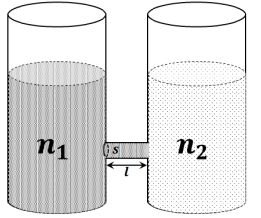
- 2As shown schematically in the figure, two vessels contain water solutions (at temperature $T$ ) of potassium permanganate $\left( KMnO _4\right)$ of different concentrations $n_1$ and $n_2\left(n_1>n_2\right)$ molecules per unit volume with $\Delta n=\left(n_1-n_2\right) \ll n_1$. When they are connected by a tube of small length $\ell$ and cross-sectional area $S , KMnO _4$ starts to diffuse from the left to the right vessel through the tube. Consider the collection of molecules to behave as dilute ideal gases and the difference in their partial pressure in the two vessels causing the diffusion. The speed $v$ of the molecules is limited by the viscous force $-\beta v$ on each molecule, where $\beta$ is a constant. Neglecting all terms of the order $(\Delta n)^2$, which of the following is/are correct? ( $k_B$ is the Boltzmann constant)-View Solution
$(A)$ the force causing the molecules to move across the tube is $\Delta n k_B T S$
$(B)$ force balance implies $n_1 \beta v \ell=\Delta n k_B T$
$(C)$ total number of molecules going across the tube per sec is $\left(\frac{\Delta n}{\ell}\right)\left(\frac{k_B T}{\beta}\right) S$
$(D)$ rate of molecules getting transferred through the tube does not change with time
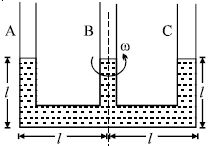
- 3Figure shows a three arm tube in which a liquid is filled upto levels of height $l$. It is now rotated at an angular frequency $\omega$ about an axis passing through arm $B$. The angular frequency $\omega$ at which level of liquid in arm $B$ becomes zero.View Solution
- 4A river $10\,m$ deep is flowing at $5\,m/s$. The shearing stress between horizontal layers of the river is :- $(\eta = 10^{-3}\,SI\,unit)$View Solution
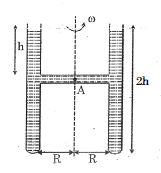
- 5The shown $H$ shaped apparatus contains an ideal incompressible liquid and has dimension as shown in figure . The diameters of the Tubes are small as compared to $h$ and $R$. The apparatus is rotated with a constant angular velocity $\omega$ about a symmetric vertical axis as shown in figure. The pressure at point $A$ isView Solution
- 6An air bubble of $1\, cm$ radius is rising at a steady rate of $2.00\, mm/sec$ through a liquid of density $1.5\, gm$ per $cm^3$. Neglect density of air. If $g$ is $1000\, cm/sec^2$, then the coefficient of viscosity of the liquid isView Solution
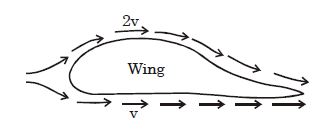
- 7The flow speeds of air on the lower and upper surfaces of the wing of an aeroplane are $v$ and $2v$ respectively. The density of air is $\rho $ and surface area of wing is $A$ . The dynamic lift on the wing isView Solution
- 8A steel wire is suspended vertically from a rigid support. When loaded with a weight in air, it extends by $l_a$ and when the weight is immersed completely in water, the extension is reduced to $l_w$. Then the relative density of material of the weight isView Solution
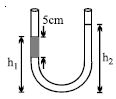
- 9An open-ended $U$-tube of uniform cross-sectional area contains water (density $1.0 $ gram/centimeter$^3$) standing initially $20$ centimeters from the bottom in each arm. An immiscible liquid of density $4.0$ grams/ centimeter $^3$ is added to one arm until a layer $5$ centimeters high forms, as shown in the figure above. What is the ratio $h_2/h_1$ of the heights of the liquid in the two arms?View Solution
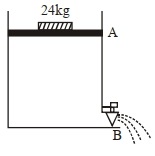
- 10Consider a water tank as shown in the figure. It's cross-sectional area is $0.4\, m ^{2}$. The tank has an opening $B$ near the bottom whose cross-section area is $1\, cm ^{2}$. A load of $24\, kg$ is applied on the water at the top when the height of the water level is $40\, cm$ above the bottom, the velocity of water coming out the opening $B$ is $v\, ms ^{-1}$. The value of $v$, to the nearest integer, is ......$m/s$. [Take value of $g$ to be $10 \,ms ^{-2}$ ]View Solution