Question
Lewis dot structures, in general, do notrepresent the actual shapes of the molecules.In case of polyatomic ions, the net charge ispossessed by the ion as a whole and not by aparticular atom. It is, however, feasible toassign a formal charge on each atom. Theformal charge of an atom in a polyatomicmolecule or ion may be defined as thedifference between the number of valenceelectrons of that atom in an isolated or freestate and the number of electrons assignedto that atom in the Lewis structure. It isexpressed as :Generally the lowest energystructure is the one with the smallestformal charges on the atoms. The formalcharge is a factor based on a pure covalentview of bonding in which electron pairsare shared equally by neighbouring atoms. The octet rule, though useful, is not universal.It is quite useful for understanding thestructures of most of the organic compoundsand it applies mainly to the second periodelements of the periodic table. There are threetypes of exceptions to the octet rule.
Bond Enthalpy It is defined as the amount of energy required to break one mole of bonds of a particular type between two atoms in a gaseous state. The unit of bond enthalpy is $kJ mol ^{-1}$. For example, the $H - H$ bond enthalpy in hydrogen molecule is $435.8 kJ mol ^{-1} \cdot H _2(g) \rightarrow H ( g )+ H ( g ) ; \Delta_{ a } H =435.8 kJ mol ^{-1}$. Bond Orderln the Lewis description of covalent bond, the Bond Order is given by the number ofbonds between the two atoms in amolecule. The bond order, for example in $H _2$ (with a single shared electron pair), in $O _2$ (with two shared electron pairs) and in $N _2$ (with three shared electron pairs) is 1,2,3respectively. A general correlation useful forunderstanding the stablities of moleculesis that: with increase in bond order, bondenthalpy increases and bond lengthdecreases. The concept of resonance was introducedto deal with the type of difficulty experiencedin the depiction of accurate structures ofmolecules like $O _3$. According to the conceptof resonance, whenever a single Lewis structure cannot describe a moleculeaccurately, a number of structures with similar energy, positions of nuclei, bonding and non-bonding pairs of electrons are taken as the canonical structures of the hybrid which describes the molecule accurately.
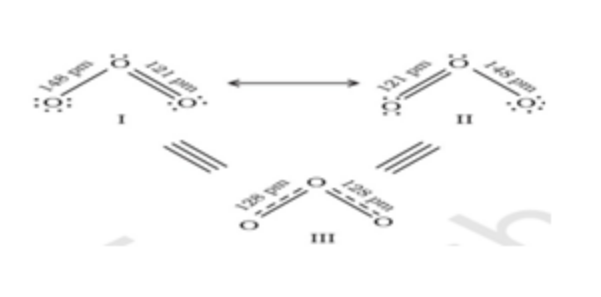
Thus for $O_3$, the two structures shown above constitute the canonical structures or resonance structures and their hybrid i.e., theIII structure represents the structure of $O_3$ more accurately. This is also called resonance hybrid. Resonance is represented by a double headed arrow. In general, it may be stated that
- The incomplete octet of the central atom
- Odd-electron molecules
- The expanded octetFrom the Kössel and Lewis treatment of theformation of an ionic bond, it follows that theformation of ionic compounds wouldprimarily depend upon:
- The ease of formation of the positive andnegative ions from the respective neutralatoms;
- The arrangement of the positive andnegative ions in the solid, that is, thelattice of the crystalline compound.
Bond Enthalpy It is defined as the amount of energy required to break one mole of bonds of a particular type between two atoms in a gaseous state. The unit of bond enthalpy is $kJ mol ^{-1}$. For example, the $H - H$ bond enthalpy in hydrogen molecule is $435.8 kJ mol ^{-1} \cdot H _2(g) \rightarrow H ( g )+ H ( g ) ; \Delta_{ a } H =435.8 kJ mol ^{-1}$. Bond Orderln the Lewis description of covalent bond, the Bond Order is given by the number ofbonds between the two atoms in amolecule. The bond order, for example in $H _2$ (with a single shared electron pair), in $O _2$ (with two shared electron pairs) and in $N _2$ (with three shared electron pairs) is 1,2,3respectively. A general correlation useful forunderstanding the stablities of moleculesis that: with increase in bond order, bondenthalpy increases and bond lengthdecreases. The concept of resonance was introducedto deal with the type of difficulty experiencedin the depiction of accurate structures ofmolecules like $O _3$. According to the conceptof resonance, whenever a single Lewis structure cannot describe a moleculeaccurately, a number of structures with similar energy, positions of nuclei, bonding and non-bonding pairs of electrons are taken as the canonical structures of the hybrid which describes the molecule accurately.
Thus for $O_3$, the two structures shown above constitute the canonical structures or resonance structures and their hybrid i.e., theIII structure represents the structure of $O_3$ more accurately. This is also called resonance hybrid. Resonance is represented by a double headed arrow. In general, it may be stated that
- Resonance stabilizes the molecule as the energy of the resonance hybrid is lessthan the energy of any single cannonical structure; and,
- Resonance averages the bond characteristics as a whole. Thus the energy of the$O_3$ . resonancehybrid is lower than either of the two cannonical froms I and II.
- Which of the following techniques used to measure bond length?
- Spectroscopic techniques
- X-ray diffraction
- Electron-diffraction techniques
- All the above
- The unit of bond enthalpy is …
- $kJ mol^{–1}$
- $Cal mol^{-1}$
- $Cal$ mol
- $kJ$ mol
- With increase in bond order, bond enthalpy… and bond length ….
- Decreases, decreases
- Increases, decreases
- Increases, increases
- Decreases, increases
- The …. is measured approximately as the radius of an atom’s core which is in contact with the core of an adjacent atom in a bonded situation.
- Ionic radius
- Metallic radius
- Covalent radius
- None of above
- … is given by the number of bonds between the two atoms in a molecule.
- Bond Order
- Bond size
- Bond enthalpy
- Bond angle