Question
What do you know about complex tissue Classify and explain its different types in plants with suitable diagrams.

Answer

The complex tissue consists of more than one type of cells having a common origin. They are of two types:
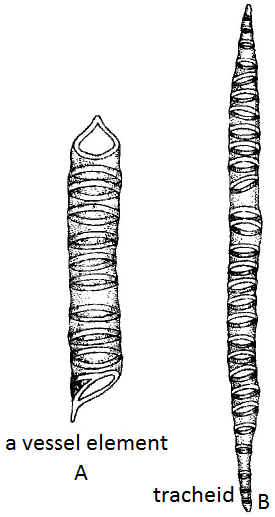
  1. Xylem: Xylem is a vascular and mechanical tissue which conducts water. Xylem is composed of cells of four different types:
  1. Tracheids.
  2. Vessels or tracheae.
  3. Xylem parenchyma.
  4. Xylem Sclerenchyma.
Except xylem parenchyma, all other xylem elements are dead and bounded by thick lignified walls. Vessels are shorter and wider than tracheids. Vessels are very long tube-like structures formed by a row of cells placed end to end. Tracheids are elongated cells with tapering ends. They also conduct water.
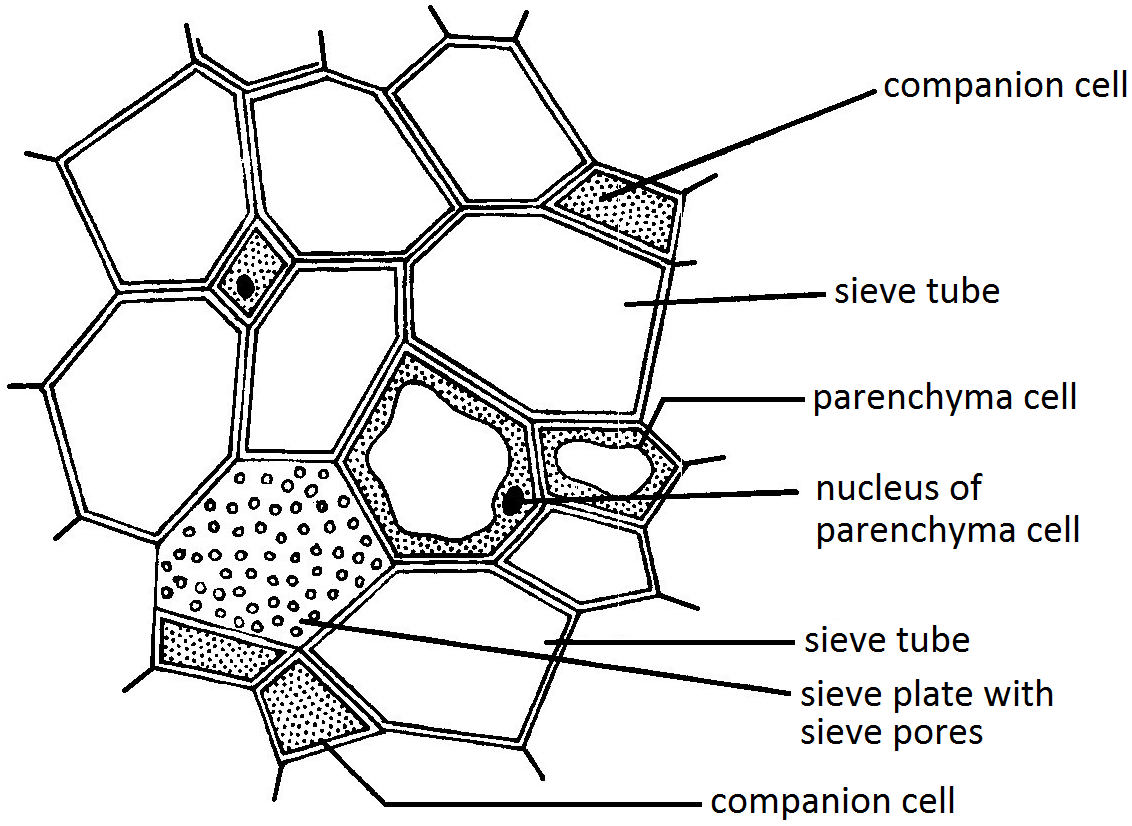
  1. Phloem: Phloem is also a vascular tissue which transports food from the leaves to the various parts of the plant. It is composed of:
  1. Sieve tubes: Sieve tubes are slender, tube-like structures composed of elongated thin-walled cells, placed end to end. Their end walls are perforated by numerous pores and are called sieve plates.
  2. Companion Cells: It is a small thin-walled cell containing dense and very active cytoplasm and large elongated nucleus.
  3. Phloem parenchyma: These are thin-walled, living cells of parenchyma of phloem. They have two functions, storage and slow lateral conduction of food.
  4. Phloem Fibres: These are thick-walled, elongated spindled shaped dead cells which posses narrow lumen. They provide mechanical strength to the tissue.

Need a full question paper?

Generate a complete, print-ready paper with questions like this in minutes — across 16+ boards, with answer keys.
Start Generating Free

Similar questions

What is a soundboard? Explain the working of a soundboard with the help of a labelled diagram.
i. Describe the role played by the lysosomes. Why are they termed as suicidal bags? How do they perform their function?
ii. What happens to the dry raisins, when placed in plain water for some time? State the reason for whatever is observed. What would happen if these raisins are then placed in concentrated salt solution?
There are three substances $X, Y$ and $Z$. The substance $X$ does not have a fixed melting point or boiling point and it still shows the individual properties of its constituents. The substance $Y$ is a pure substance which occurs in nature as such. The substance $Y$ has a fixed melting point and boiling point but it cannot be broken down into simpler substances by any chemical means. The substance $Z$ is also a pure substance whose properties are entirely different from those of its constituents. The substance $Z$ can, however, be divided by electrolysis into two substances which belong to the same class of substances as $Y$.
  1. What type of substance could $X$ be? Name one substance like $X$.
  2. What type of substance could $Y$ be? Name one substance like $Y$.
  3. What type of substance could $Z$ be? Name one substance like $Z$.
  4. Whish process involves absorption or release of an appreciable amount of energy: formation of substance $X$ or formation of substance $Z$?
  5. Name the three groups into which all the substances like $Y$ are divided on the basis of their properties.
What is the difference between a compression and a rarefaction in a sound wave? Illustrate your answer with a sketch.
Show by using the graphical method that:
$\text{s}=\text{ut}+\frac{1}{2}\text{at}^2$
where the symbols have their usual meanings.
Differentiate between sclerenchyma and parenchyma tissue. Draw well labelled diagram.
State and explain the law of conservation of energy with an example.
What does a neuron look like?
Write a note on plasmolysis.

  1. Identify the figure and write down its class.
  2. Label $A, B, C,$ and $D.$
  3. What if its respiratory organs$?$
  4. What type of adaptation this creature has$?$
  5. What type of endoskeleton it has$?$