Question
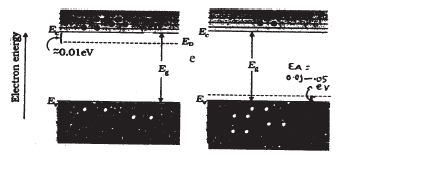
What is an intrinsic semiconductor? How can this material be converted into (1) P-type (2) N-type extrinsic semiconductor? Explain with the help of energy band diagrams.
Answer

Intrinsic semiconductor: Pure semi-conductor having no impurities or negligible impurities.Conversion into –
  1. P-type – by doping with small amount of trivalent impurities.
  2. N-type- by doping with small amount of pentavalent impurity.
 

Need a full question paper?

Generate a complete, print-ready paper with questions like this in minutes — across 16+ boards, with answer keys.

Start Generating Free

Similar questions

Two neutral particles are kept $1m$ apart. Suppose by some mechanism some charge is transferred from one particle to the other and the electric potential energy lost is completely converted into a photon. Calculate the longest and the next smaller wavelength of the photon possible.
Arrange electromagnetic radiations in the ascending order of their frequencies. Write uses of any one of them-Micro waves, Radio waves, X-rays, gamma rays.
A straight wire of length l can slide on two parallel plastic rails kept in a horizontal plane with a separation d. The coefficient of friction between the wire and the rails is $\mu.$ If the wire carries a current i, what minimum magnetic field should exist in the space in order to slide the wire on the rails?
Plot a graph showing the variation of binding energy per nucleon as a function of mass number. Which property of nuclear force explains the approximate constancy of binding energy in the range 30 < A < 170? How does one explain the release of energy in both the processes of nuclear fission and fusion from the graph?
The magnifying power of a converging lens used as a simple microscope is $\Big(1+\frac{\text{D}}{\text{f}}\Big).$ A compound microscope is a combination of two such converging lenses. Why don't we have magnifying power $\Big(1+\frac{\text{D}}{\text{f}_\text{o}}\Big) \Big(1+\frac{\text{D}}{\text{f}_\text{o}}\Big)?$ In other words, why can the objective not be treated as a simple microscope but the eyepiece can?
A metallic rod of length ‘l’ is rotated with a frequency v with one end hinged at the centre and the other end at the circumference of a circular metallic ring of radius r, about an axis passing through the centre and perpendicular to the plane of the rinig. A constant uniform magnetic field B parallel to the axis is present every where. Using Lorentz force, explain how emf is induced between the centre and the metallic ring and hence obtain the expression for it.
Potential at an instant $t$ in an ac circuit is $E=200 \sin 157 t . \cos 157 t$ volts and current is $I=\sin \left(314 t+\frac{\pi}{3}\right) \quad$ Amperes. In this condition calculate :
(a) frequency
(b) root mean square value of voltage
(c) impedance of the circuit
(d) power factor.
A piece of wire carrying a current of 6.00A is bent in the form of a circular arc of radius 10.0cm, and it subtends an angle of 120° at the centre. Find the magnetic field B due to this piece of wire at the centre.
  1. Depict the equipotential surfaces for a system of two identical positive point charges placed a distance $‘d\ ’$ apart.
  2. Deduce the expression for the potential energy of a system of two point charges $q_1$ and $q_2$ brought from infinity to the points$\overrightarrow{\text{r}_{1}}$ and $\overrightarrow{\text{r}_{2}}$ respectively in the presence of external electric field $\overrightarrow{\text{E}}.$
An electric bulb of volume $250\ cc$ was sealed during manufacturing at a pressure of $10^{-3}\ mm$ of mercury at $27^\circ C.$ Compute the number of air molecules contained in the bulb. Avogadro constant $= 6 \times 10^{23}\ mol^{-1},$ density of mercury $= 13600\ kg/ m^{-3}$ and $g = 10\ ms^{-2}.$