Question
What is the difference between the terms ‘hydrolysis’ and ‘hydration’?

Answer

Hydrolysis is a chemical reaction in which a substance reacts with water under neutral, acidic or alkaline conditions.
$\text{Na}_2\text{CO}_3\ +\ 2\text{H}_2\text{O}\xrightarrow{\ \ \ \ \ \ \ \ \ \ \ \ \ }2\text{NaOH}\ +\ \text{H}_2\text{CO}_3\\ \text{ Salt 1} \ \ \ \ \ \ \ \ \ \ \ \ \ \ \ \ \ \ \ \ \ \ \ \ \ \ \ \ \ \ \ \ \ \ \ \text{Base 2}\ \ \ \ \ \ \ \ \text{ Acid 1}$
Hydration on the other hand is the property of a chemical compound to take up molecules of water of crystallisation and get, hydrated.
$\text{Cu}\text{SO}_4(\text{s})\ +\ 5\text{H}_2\text{O(l)}\xrightarrow{\ \ \ \ \ \ \ \ \ \ \ \ \ }\text{CuSO}_4\ 5\ \text{H}_2\text{O}(\text{s})\\ \text{colorless} \ \ \ \ \ \ \ \ \ \ \ \ \ \ \ \ \ \ \ \ \ \ \ \ \ \ \ \ \ \ \ \ \ \ \ \ \ \ \text{(Blue)}$

Need a full question paper?

Generate a complete, print-ready paper with questions like this in minutes — across 16+ boards, with answer keys.
Start Generating Free

Similar questions

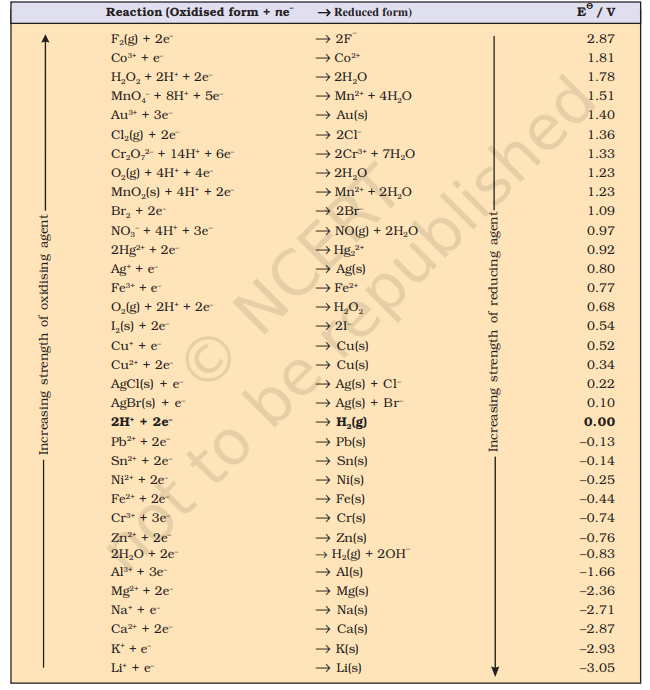
Using the standard electrode potentials given in the Table, predict if the reaction between the following is feasible:

$\mathrm{Fe}^{3+}(\mathrm{aq})$ and $\mathrm{Cu}(\mathrm{s})$.
Phosphoric acid is preferred over sulphuric acid in preparing hydrogen peroxide from peroxides. Why?
Explain why the electron gain enthalpy of fluorine is less negative than that of chlorine.
Discuss the concept of hybridisation. What are the different types of hybridization that carbon can exhibit?
Use the information and data given below to answer the questions (a) to (c):
  • Stronger intermolecular forces result in higher boiling point.
  • Strength of London forces increases with the number of electrons in the molecule.
  • Boiling point of HF, HCl, HBr and HI are 293 K, 189 K, 206 K and 238 K respectively.
  1. Which type of intermolecular forces are present in the molecules HF, HCl, HBr and HI?
  2. Looking at the trend of boiling points of HCl, HBr and HI, explain out of dipole interaction and London interaction, which one is predominant here.
  3. Why is boiling point of hydrogen fluoride highest while that of hydrogen chloride lowest?
Define environmental chemistry.
Similar to electron diffraction, neutron diffraction microscope is also used for the determination of the structure of molecules. If the wavelength used here is 800pm, calculate the characteristic velocity associated with the neutron.
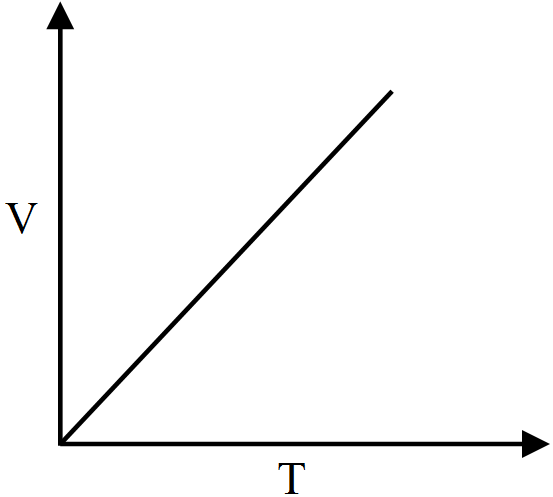
  1. Which gas law is shown by the following graph?
  1. Calculate the temperature of 4.0mol of gas occupying $5dm^3$​​​​​​​ at 332 bar.
[$R = 0.083$bar $dm3mol^{-1}K]$
Calculate the weight of FeO formed from 2 g of VO and 5.75 g of $Fe _2 O _3$. Also, report the limiting reagent.
$2 VO+3 Fe_2 O 3 \rightarrow 6 FeO+V_2 O_5$
(Atomic mass of $V =51.4, O =16, Fe =55.9 g$ )
  1. Using the data given below, calculate the value of equilibrium constant for the reaction at 298K.
$3\text{CH}\equiv\text{CH}(\text{g})\rightleftharpoons\text{C}_6\text{H}_6(\text{g})$ assuming ideal gas behaviour, $\Delta_\text{f}\text{G}^\circ[\text{HC}\equiv\text{CH(g)}]=2.09\times10^5\text{J mol}^{-1},$ $\Delta_\text{f}\text{G}^\circ[\text{C}_6\text{H}_6(\text{g})]=1.24\times10^5\text{J mol}^{-1}, \mathrm{R}=8.314 \mathrm{JK}^{-1} \mathrm{~mol}^{-1}$.
  1. Based on your calculated value, comment whether this process can be recommended as a practical method for making benzene.