Question
  1. What type of intermediate species are formed by homolytic fission?
  2. Which substance is used as adsorbent in thin layer chromatography?
  3. Why is resonance hybrid is more stable than resonating structures?
  4. In Kjeldahl's method, which compound is formed during digestion i.e., reaction of organic compound with conc. $H_2SO_4$ on heating?
  5. Why is HCOOH more acidic than $CH_3COOH$?
Answer

  1. Free radicals are formed by homolytic fission.
  2. Silica gel is used in thin layer chromatography.
  3. It is because resonance hybrid has lower energy as compared to resonating structures.
  4. $NH_3$ liberated by organic compounds reacts with $H_2SO_4$ to form ammonium sulphate.
  5. It is because $\ \ \ \ \ \ \ {\text{O}}\\\ \ \ \ \ \ \ \ \|\\\text{H}-\text{C}-\text{O}^{\ominus}$ is more stable than $\ \ \ \ \ \ \ \ \ \ \ \ \ \text{O}\\\ \ \ \ \ \ \ \ \ \ \ \ \ \|\\\text{CH}_3-\text{C}-\text{O}^{\ominus}$
group is electron releasing, it will increase negative charge on acetate ion making it unstable.

Need a full question paper?

Generate a complete, print-ready paper with questions like this in minutes — across 16+ boards, with answer keys.

Start Generating Free

Similar questions

  1. Complete the equations for:
  1. $\text{BF}_3+\text{LiH}\rightarrow$
  2. $\text{B}_2\text{H}_6+\text{H}_2\text{O}\rightarrow$
  1. Give reasons:
  1. Conc $HNO_3$ is transported in aluminium container.
  2. Graphite is used as lubricant.
  3. Lead (IV) chloride is highly unstable towards heat.
Match the species in Column I with the type of hybrid orbitals in Column II.
 
Column I
 
Column II
i.
Tetrahedral
a.
$\text{sp}^2$
ii.
Trigonal
b.
$\text{sp}$
iii.
Linear
c.
$\text{sp}^3$
Give a brief description of the principles of the following techniques taking an example in each case.
Crystallisation
  1. Commercially available concentrated hydrochloric acid contains $45\%$ HCl by mass.
  1. What is the molarity of this solution? The density is $1.19g$ mL.
  2. What volume of cone. HCl is required to make $1.00L$ of $0.24M$ HCl?
  1. Write the balanced chemical equations for the following:
  1. $KMnO_4 + NH3 \rightarrow MnO_2 +KOH+ H_2O + N_2$
  2. $HNO_3 + P_4\rightarrow NO_2 + H_3PO_4 + H_2O$
What is meant by ‘demineralised’ water and how can it be obtained?
The ionization constant of benzoic acid is $6.46 \times 10^{–5}$ and $K_{sp}$ for silver benzoate is $2.5 \times 10^{–13}$. How many times is silver benzoate more soluble in a buffer of $pH\ 3.19$ compared to its solubility in pure water?
Pressure of $1$ g of an ideal gas A at $27^{\circ} C$ is found to be $2$ bar. When $2$ g of another ideal gas B is introduced in the same flask at same temperature the pressure becomes $3$ bar. Find a relationship between their molecular masses.
What are the major differences between metals and non-metals?
Attempt any five of the following:
1. Why are Alkenes called olefins?
2. Convert 1-bromopropane to 2-bromopropane.
3. If Qc < Kc, when we continuously remove the product, what would be the direction of the reaction?
4. Convert methane into ethane.
5. What are cycloalkanes?
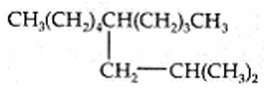
6. Write IUPAC name of following:
Image
7. How will you convert ethanoic acid into ethene?
Write chemical reactions to justify that hydrogen peroxide can function as an oxidising as well as reducing agent.